Daniel Craig has a licence to thrillDaniel Craig brings a toughness to his Bond which puts him in the same league as Sean Connery as one of the great interpreters of the role
By Eleanor Ringel GillespieoNY TIMES NEWS SERVICE, ATLANTA
Imagine, if you can, you've never heard of someone named James Bond. That martinis shaken or stirred meant nothing to you. That the number 007 made no particular sense and M was just a letter in the alphabet.
Imagine you've never experienced the Wow Factor. The stunts, the exotic locales, the gorgeous women, the despicable bad guys.
And then, at a multiplex near you, there appears a galvanizing new action hero — though you're not quite sure he should be counted as entirely heroic. And he's played by sexy Daniel Craig, an English actor whose name you may not know but whose charisma and extraordinary acting chops have drifted stateside in movies including Layer Cake, Road to Perdition, Munich and Infamous (as killer Perry Smith).
Welcome to Casino Royale.
Based on Ian Fleming's first Bond novel — an earlier version in 1967 was made as a spoof starring David Niven and Woody Allen — the new 007 movie could be considered a re-imagining of the most famous spy in movie history. Or perhaps simply a kind of "Bond Begins."
Gone are the puerile double-entendres — funny when Sean Connery first uttered them more than 40 years ago, but a little tired now. Also MIA are the gyrating girls over the opening credits and, for that matter, the traditionally spectacular special-effects-in-the-extreme pre-credit prologue.
This Bond means business, and to make sure you know it, the picture opens with a black-and-white sequence in which Bond earns his double-0 status — that's two kills, if you please. First is a bloody bashing in a white-tiled public lavatory that's as unglamorous as a Martin Scorsese gang hit. The next one is, as our blond (get used to it) Bond notes, easier. Considerably.
Let the iconography begin. The familiar iris shot encircles him, the classic chords ring out, the movie bursts into color — and we're off and running with a Bond film worthy of, well, Sean Connery.
As always, the plot doesn't stand up to much scrutiny. A no-good named Le Chiffre (Mads Mikkelsen) makes a living financing terrorists. Certain bad bets on the stock market bring him to a high-stakes poker game in Montenegro. The inimitable M (inimitable Judi Dench) — who so far has dismissed her newest double-0 as nothing more than "a blunt instrument" — dispatches Bond to beat Le Chiffre at his own game, on and off the gaming table.
Director Martin Campbell, who gave us the very respectable GoldenEye in 1995, and writers Neal Purvis and Robert Wade, whose script has been sweetened by Crash's Oscar-winning Paul Haggis, approach the essential Bond tropes much as Peter Jackson did the special effects in his The Lord of the Rings trilogy. That is, in service of plot and character. We learn how Bond acquired that spiffy Aston Martin (in a card game). How he came by his first tailored tux, thanks to M-dispatched chaperone/love interest Vesper Lynd (gorgeous and talented Eva Green). And, in the crowd-pleasing moment of a crowd-pleasing movie, what he said the first time he was asked if he liked his martini shaken or stirred. To wit: "Do I look like I give a damn?"
Casino Royale does just about everything right. A breathtaking chase over, under, around and through a construction site includes some fancy stuff on a gigantic crane worthy of Jackie Chan at his most agile and death-defying. (Another plus: The movie relies more on stunt men than special effects.) The extravagantly beautiful Green makes for an expert sparring partner. Told she's not his type, she flippantly asks, "Smart?"
No, he replies. "Single."
Die-hard fans may miss Q and Miss Money-penny or the boys-and-their-toys gadgets or even the smirky tone. But in their stead is a riveting picture that, for all its globe-trotting glamour and eye-popping action, demands we take this new Bond seriously.
And why not? Craig is definitely the Real Thing — dangerous, seductive, with a wired intensity that, along with his irradiated blue eyes, calls to mind Connery's sex-symbol contemporary, Steve McQueen. Roger Moore was — let's face it — a charming buffoon. Timothy Dalton brought back the menace, but was never comfortable in the role. Pierce Brosnan brought back the humor, but was ultimately too comfortable in the role.
They all — with the possible exception of Moore, who sauntered through his films as if he were hosting a James Bond Film Festival, not playing the title role — worked in Connery's shadow. Craig doesn't replace the first, once-and-forever 007, but he brings a ferocity and sinewy sexiness to the part (he's naked more than Green is, most memorably in an already much talked about torture scene) that's totally new, totally right and yet takes nothing away from Bond No. 1.
OK, the movie is about 20 minutes too long. And we're not always sure who is doing what to whom or why. (Luckily, M explains all.)
Still, Craig and company have aired out 007, buffed him up and taught an old horndog some new tricks. As Vesper says to Bond, "Just because you've done something doesn't mean you have to keep on doing it."
Daniel Craig does Bond differently. He does him better. And I hope he does him for a good long time. This story has been viewed 3 times.
Thursday, November 16, 2006

9/11: Conspiracy Theory vs Popular Mechanics
http://www.loosechange911.com/
http://video.google.com/videoplay?docid=7866929448192753501
http://video.google.ca/videoplay?docid=-3214024953129565561
http://www.lolloosechange.co.nr/
http://www.myspace.com/screwloosechange
Dylan Avery has a theory that he says casts doubts on Mark Bingham's actions on Sept. 11, 2001. According to Avery, the San Francisco public relations executive never called his mom on a cell phone from the cabin of Flight 93, and never told her that "some of us here are going to try to do something." Instead, says Avery, someone using a voice synthesizer -- possibly a government official -- called Alice Hoglan on the morning that Flight 93 -- and Bingham -- became part of Sept. 11 lore.
"The cell phone calls were fake -- no ifs, ands or buts," Avery says in "Loose Change," a film he wrote and directed that's one of the most-watched movies on the Internet, with 10 million viewers in the past year. "Until the government can prove beyond a shadow of doubt that al Qaeda was behind Sept. 11, the American people have every reason to believe otherwise."
Avery is one of perhaps millions of Americans who believe the U.S. government -- or rogue elements within it -- either orchestrated the attacks or tacitly supported them for nefarious reasons.
As the five-year anniversary of the attacks approaches, the clamor of Avery and other conspiracy theorists has gotten stronger -- and more widely accepted. According to a poll by Ohio University and Scripps Howard News Service, 36 percent of Americans believe that government officials "either assisted in the 9/ 11 attacks or took no action to stop the attacks because they wanted the United States to go to war in the Middle East." Twelve percent of Americans believe a cruise missile fired by the U.S. military -- not an American Airlines jet hijacked by Arab terrorists -- slammed into the Pentagon. Sixteen percent of Americans, the survey indicates, believe that "secret explosives" -- not two planes and the resulting damage -- brought down the World Trade Center towers.
Conspiracy fans are viewed by most people as gullible, opportunistic, disgruntled or simply suspicious. It's widely believed that conspiracy theorists emanate from the margins of society, that they're a combination of paranoid, powerless, undereducated and desperate (at least desperate to assign blame). But Avery and other prominent Sept. 11 conspiracy theorists claim to represent society's mainstream, which is skeptical of the Bush administration's rationale for the Iraq war and Washington's version of what really happened that day.
Some of them reject the term "conspiracy theorist," instead calling themselves "truth activists" -- people who want to expose hidden facts that the major media ignore or downplay because of their corporate ties. While many conspiracy theorists are politically liberal, they also include people on the right, including members of the John Birch Society, who imply that the Sept. 11 attacks were part of a continuing plan by U.S. elites to create a "New World Order" and impose greater control over Americans.
Some conspiracy theories are fantastical (CIA agents orchestrated the attacks; Israel planned them.) -- the epitome of preposterous beliefs that start with a conclusion and work backward to find evidence. Each new month brings a deluge of crackpot theories, but a growing number of people say there are too many improbabilities -- too many illogical holes -- in the government's version of what happened.
Robert Bowman, who directed the "Star Wars" defense program under Presidents Gerald Ford and Jimmy Carter, reached his own conclusion after questioning (among other things) why the American military hadn't intercepted the hijacked planes before they hit the Pentagon and the World Trade Center, why the FBI had ignored repeated pre-Sept. 11 warnings that Zacarias Moussaoui wanted to fly a plane into the World Trade Center, why the Pentagon didn't release surveillance tapes of American Airlines Flight 77 hitting the military complex, and how, within hours after the attack, the government could so quickly produce the names and photos of the 19 hijackers.
A former U.S. Air Force lieutenant colonel with a doctorate from the California Institute of Technology, Bowman says Vice President Dick Cheney and other top government officials may have had advance knowledge of the attacks. Bowman theorizes that Cheney and other officials stood to benefit financially (in Cheney's case, through Halliburton). Labeling these officials "neo-cons," Bowman says they had a long-standing desire to control Iraq's oil and to use the country as a strategic hub for controlling the entire Middle East. The Sept. 11 commission, he says, neglected to investigate these possible connections, leaving a huge gap in the official account.
"It's hard to believe that somebody at some (government) level wasn't complicit in this thing," Bowman said in a phone interview from his home in Florida. Bowman, who publicly turned against the "Star Wars" system because he believed the Reagan administration secretly considered it a first-strike option and not merely a defensive weapon, says, "How could someone in the FBI turn down requests 70 times from somebody (FBI agent Harry Samit) who said he thought Moussaoui was going to fly a hijacked plane into the World Trade Center? ... I'm calling for a (new) independent investigation that will clear up everything. If the investigation shows that there were people in the United States who were involved in some way, that's the story of the century, and the American people need to know it."
Like many on the left and the right, Bowman points to pre-Sept. 11 documents he says foreshadowed the attacks, including a paper published in 2000 by the Project for a New American Century, a conservative think tank whose members have included Cheney, Donald Rumsfeld and Paul Wolfowitz. The paper, titled "Rebuilding America's Defenses," talked about the fact that a "catastrophic and catalyzing event -- a new Pearl Harbor," would strengthen the American military because lawmakers would, given the urgency, green-light funds to continue the military's dominance over U.S. adversaries. For conspiracy theorists, the Project for a New American Century document is a smoking gun. Its reference to Pearl Harbor is both scary and damning, they say, because some historians believe President Franklin Roosevelt knew that an attack on U.S. soil was imminent but let it happen to rally American public opinion behind going to war.
If that isn't enough evidence to convince you that Sept. 11 was an inside job, conspiracy theorists say, there's more. What about the fact that NORAD (North American Aerospace Defense Command) quickly intercepted golfer Payne Stewart's wayward Learjet in 1999 but didn't intercept the hijacked planes that crashed in New York, Washington and Shanksville, Pa.? What about the fact that witnesses at the World Trade Center reported hearing multiple explosions before the buildings' collapse, indicating to some that the towers were brought down by planted explosives? What about the fact that Building 7 of the World Trade Center -- the 47-floor structure housing offices of the CIA, the Secret Service and the Department of Defense -- collapsed even though it wasn't hit by planes?
Rebuttals have emerged to explain some of the biggest question marks. Last month, Popular Mechanics magazine published a full-length book, "Debunking 9/11 Myths: Why Conspiracy Theories Can't Stand Up to the Facts," which refuted 20 claims widely held by conspiracy theorists. For example, the belief that a missile hit the Pentagon was based partly on the visible damage to the building: at the point of impact, a relatively small portion of the wall was knocked over -- it wasn't the horizontal damage to be expected from a large-winged Boeing 757.
Popular Mechanics, which interviewed more than 300 sources for its book, quotes witnesses who said at least one wing of Flight 77 smashed into an on-ground generator before the plane struck the Pentagon. An engineering expert says the plane's outer wings likely sheared off before impact. "A jet doesn't punch a cartoonlike outline into a concrete building upon impact," the book says, citing an engineering professor.
What about a witness who supposedly told CNN that he saw a missile hit the Pentagon? Popular Mechanics interviews the witness, Mike Walter, who says his original words ("I looked out my window and saw this plane, this jet, an American Airlines jet, coming. ... I mean, it was like a cruise missile with wings") were truncated and distorted by conspiracy theorists. One of those theorists was French author Thierry Meyssan, whose 2002 best-seller, "The Horrifying Fraud," claimed the U.S. military instigated Sept. 11 as part of its plan to start new wars around the world.
In his film "Loose Change," Avery says Bingham and other passengers on Flight 93 could not have called from the doomed jetliner because cell phones rarely work at high altitudes. He cites a research paper by A.K. Dewdney, an emeritus professor of computer science at the University of Western Ontario. But in "Debunking 9/11 Myths," Popular Mechanics interviews experts who explain why Bingham's cell phone would have worked that day (the plane's low altitude helped, as did the fact it flew over rural areas, which often have cell-phone towers with powerful signal capacities).
Not surprisingly, conspiracy theorists have attacked "Debunking 9/11 Myths," saying that Popular Mechanics is a front for the CIA. They that one of its researchers, Benjanim Chertoff, is related to Homeland Security Director Michael Chertoff, which they say is an indication of the magazine's co-mingling with a government that was behind the attacks. (The magazine says the two Chertoffs might be distant cousins, but that they've never spoken.)
Conspiracy theorists might even look at this article as part of the conspiracy, because Hearst Corp., which owns Popular Mechanics, also publishes The Chronicle.
What sets "Loose Change" apart from other Sept. 11 works is that it's visually appealing, slickly edited (with hip music) and free to watch on the internet video site YouTube. It has an anti-authoritarian edge (Avery is 22 years old) that might appeal to someone who admires Michael Moore or Jon Stewart. The film has inspired a critical response, "Screw Loose Change," which repackages Avery's film with rebuttals interspersed.
Conspiracy theorists often cite "facts" that really are facts, but whether they really add up to anything is another question.
In his new book, "The Terror Conspiracy: Deception, 9/11, and the Loss of Liberty," author Jim Marrs points out that former national security adviser Zbigniew Brzezinski admitted that the United States began funding Afghan rebels in July 1979. Why is this important? Because, for many years, the official American version was that funding started after the Soviet Union invaded Afghanistan in December 1979. Brzezinski now says the United States hoped the 1979 funding would draw in the Soviets and lead to a wider war, contributing to the demise of the Soviet Union. If the U.S. government would lie in 1979, why wouldn't it lie again in 2001? In 1979, says Marrs, it was about gaining access to oil and gas in Central Asia. Twenty-two years later, he says, it was about Iraq's oil.
Agreeing with Marrs is Scholars for 9/11 Truth, an organization that believes the U.S. government "permitted 9/11 to occur." Among the group's members are Paul W. Rea, a humanities lecturer at St. Mary's College in Moraga; Tracy Belvins, a research scientist in bioengineering at Rice University; Kevin Barrett, a lecturer at the University of Wisconsin-Madison whose Sept. 11 views caused national controversy in July and prompted some lawmakers to insist he shouldn't be teaching at the university; and Stephen LeRoy, an economics professor at UC Santa Barbara who has been a visiting economist at the Federal Reserve Bank of San Francisco.
"Conspiracists (come) from all parts of the population, they (come) from all racial and religious groups," says Bob Goldberg, a history professor at the University of Utah and the author of "Enemies Within: The Culture of Conspiracy in Modern America." "The fact that people who have advanced degrees believe in conspiracy theories does not surprise me because it's not an issue of whether you're smart or dumb. In fact, when you look at conspiracy theories, what distinguishes them is how rigorously logical they seem to be, that they are so intensely structured and that there's a belief that every single fact is important and connects to another fact. There's a rigor to (their) logic."
"But," says Goldberg, "there's (an inflexibility to) the logic that denies things you can't deny -- whether it's accidents, whether it's bureaucratic process, whether it's miscalculations, whether it's simply mistakes. In these theories, there are no mistakes, no accidents, no bureaucracy -- everything is crystal clear."
"Debunking 9/11 Myths" makes the case that mistakes, miscommunication and bureaucratic bungling contributed to the U.S. government's lack of immediate response to the Sept. 11 hijackings. Barrett and other conspiracy theorists will have none of it. They say the U.S. government's version of the events is itself a conspiracy theory -- a collection of assumptions bolstered by evidence, but nevertheless assumptions that are open to debate.
"After studying this fairly intensively over the past 2 1/2 years," says Barrett in a phone interview, "I'm convinced that 9/11 was orchestrated by top U.S. officials and presumably perpetrated by members of what could be called the American allied intelligence community."
Goldberg says conspiracy theorists -- especially those fearful and distrustful of a powerful, centralized government -- have existed in the United States since its founding. The attacks of Sept. 11, 2001, Goldberg says, created a perfect storm for conspiracy theorists of every political and religious persuasion.
Five years afterward, the storm isn't abating.
E-mail Jonathan Curiel at jcuriel@sfchronicle.com.
http://video.google.com/videoplay?docid=7866929448192753501
http://video.google.ca/videoplay?docid=-3214024953129565561
http://www.lolloosechange.co.nr/
http://www.myspace.com/screwloosechange
Dylan Avery has a theory that he says casts doubts on Mark Bingham's actions on Sept. 11, 2001. According to Avery, the San Francisco public relations executive never called his mom on a cell phone from the cabin of Flight 93, and never told her that "some of us here are going to try to do something." Instead, says Avery, someone using a voice synthesizer -- possibly a government official -- called Alice Hoglan on the morning that Flight 93 -- and Bingham -- became part of Sept. 11 lore.
"The cell phone calls were fake -- no ifs, ands or buts," Avery says in "Loose Change," a film he wrote and directed that's one of the most-watched movies on the Internet, with 10 million viewers in the past year. "Until the government can prove beyond a shadow of doubt that al Qaeda was behind Sept. 11, the American people have every reason to believe otherwise."
Avery is one of perhaps millions of Americans who believe the U.S. government -- or rogue elements within it -- either orchestrated the attacks or tacitly supported them for nefarious reasons.
As the five-year anniversary of the attacks approaches, the clamor of Avery and other conspiracy theorists has gotten stronger -- and more widely accepted. According to a poll by Ohio University and Scripps Howard News Service, 36 percent of Americans believe that government officials "either assisted in the 9/ 11 attacks or took no action to stop the attacks because they wanted the United States to go to war in the Middle East." Twelve percent of Americans believe a cruise missile fired by the U.S. military -- not an American Airlines jet hijacked by Arab terrorists -- slammed into the Pentagon. Sixteen percent of Americans, the survey indicates, believe that "secret explosives" -- not two planes and the resulting damage -- brought down the World Trade Center towers.
Conspiracy fans are viewed by most people as gullible, opportunistic, disgruntled or simply suspicious. It's widely believed that conspiracy theorists emanate from the margins of society, that they're a combination of paranoid, powerless, undereducated and desperate (at least desperate to assign blame). But Avery and other prominent Sept. 11 conspiracy theorists claim to represent society's mainstream, which is skeptical of the Bush administration's rationale for the Iraq war and Washington's version of what really happened that day.
Some of them reject the term "conspiracy theorist," instead calling themselves "truth activists" -- people who want to expose hidden facts that the major media ignore or downplay because of their corporate ties. While many conspiracy theorists are politically liberal, they also include people on the right, including members of the John Birch Society, who imply that the Sept. 11 attacks were part of a continuing plan by U.S. elites to create a "New World Order" and impose greater control over Americans.
Some conspiracy theories are fantastical (CIA agents orchestrated the attacks; Israel planned them.) -- the epitome of preposterous beliefs that start with a conclusion and work backward to find evidence. Each new month brings a deluge of crackpot theories, but a growing number of people say there are too many improbabilities -- too many illogical holes -- in the government's version of what happened.
Robert Bowman, who directed the "Star Wars" defense program under Presidents Gerald Ford and Jimmy Carter, reached his own conclusion after questioning (among other things) why the American military hadn't intercepted the hijacked planes before they hit the Pentagon and the World Trade Center, why the FBI had ignored repeated pre-Sept. 11 warnings that Zacarias Moussaoui wanted to fly a plane into the World Trade Center, why the Pentagon didn't release surveillance tapes of American Airlines Flight 77 hitting the military complex, and how, within hours after the attack, the government could so quickly produce the names and photos of the 19 hijackers.
A former U.S. Air Force lieutenant colonel with a doctorate from the California Institute of Technology, Bowman says Vice President Dick Cheney and other top government officials may have had advance knowledge of the attacks. Bowman theorizes that Cheney and other officials stood to benefit financially (in Cheney's case, through Halliburton). Labeling these officials "neo-cons," Bowman says they had a long-standing desire to control Iraq's oil and to use the country as a strategic hub for controlling the entire Middle East. The Sept. 11 commission, he says, neglected to investigate these possible connections, leaving a huge gap in the official account.
"It's hard to believe that somebody at some (government) level wasn't complicit in this thing," Bowman said in a phone interview from his home in Florida. Bowman, who publicly turned against the "Star Wars" system because he believed the Reagan administration secretly considered it a first-strike option and not merely a defensive weapon, says, "How could someone in the FBI turn down requests 70 times from somebody (FBI agent Harry Samit) who said he thought Moussaoui was going to fly a hijacked plane into the World Trade Center? ... I'm calling for a (new) independent investigation that will clear up everything. If the investigation shows that there were people in the United States who were involved in some way, that's the story of the century, and the American people need to know it."
Like many on the left and the right, Bowman points to pre-Sept. 11 documents he says foreshadowed the attacks, including a paper published in 2000 by the Project for a New American Century, a conservative think tank whose members have included Cheney, Donald Rumsfeld and Paul Wolfowitz. The paper, titled "Rebuilding America's Defenses," talked about the fact that a "catastrophic and catalyzing event -- a new Pearl Harbor," would strengthen the American military because lawmakers would, given the urgency, green-light funds to continue the military's dominance over U.S. adversaries. For conspiracy theorists, the Project for a New American Century document is a smoking gun. Its reference to Pearl Harbor is both scary and damning, they say, because some historians believe President Franklin Roosevelt knew that an attack on U.S. soil was imminent but let it happen to rally American public opinion behind going to war.
If that isn't enough evidence to convince you that Sept. 11 was an inside job, conspiracy theorists say, there's more. What about the fact that NORAD (North American Aerospace Defense Command) quickly intercepted golfer Payne Stewart's wayward Learjet in 1999 but didn't intercept the hijacked planes that crashed in New York, Washington and Shanksville, Pa.? What about the fact that witnesses at the World Trade Center reported hearing multiple explosions before the buildings' collapse, indicating to some that the towers were brought down by planted explosives? What about the fact that Building 7 of the World Trade Center -- the 47-floor structure housing offices of the CIA, the Secret Service and the Department of Defense -- collapsed even though it wasn't hit by planes?
Rebuttals have emerged to explain some of the biggest question marks. Last month, Popular Mechanics magazine published a full-length book, "Debunking 9/11 Myths: Why Conspiracy Theories Can't Stand Up to the Facts," which refuted 20 claims widely held by conspiracy theorists. For example, the belief that a missile hit the Pentagon was based partly on the visible damage to the building: at the point of impact, a relatively small portion of the wall was knocked over -- it wasn't the horizontal damage to be expected from a large-winged Boeing 757.
Popular Mechanics, which interviewed more than 300 sources for its book, quotes witnesses who said at least one wing of Flight 77 smashed into an on-ground generator before the plane struck the Pentagon. An engineering expert says the plane's outer wings likely sheared off before impact. "A jet doesn't punch a cartoonlike outline into a concrete building upon impact," the book says, citing an engineering professor.
What about a witness who supposedly told CNN that he saw a missile hit the Pentagon? Popular Mechanics interviews the witness, Mike Walter, who says his original words ("I looked out my window and saw this plane, this jet, an American Airlines jet, coming. ... I mean, it was like a cruise missile with wings") were truncated and distorted by conspiracy theorists. One of those theorists was French author Thierry Meyssan, whose 2002 best-seller, "The Horrifying Fraud," claimed the U.S. military instigated Sept. 11 as part of its plan to start new wars around the world.
In his film "Loose Change," Avery says Bingham and other passengers on Flight 93 could not have called from the doomed jetliner because cell phones rarely work at high altitudes. He cites a research paper by A.K. Dewdney, an emeritus professor of computer science at the University of Western Ontario. But in "Debunking 9/11 Myths," Popular Mechanics interviews experts who explain why Bingham's cell phone would have worked that day (the plane's low altitude helped, as did the fact it flew over rural areas, which often have cell-phone towers with powerful signal capacities).
Not surprisingly, conspiracy theorists have attacked "Debunking 9/11 Myths," saying that Popular Mechanics is a front for the CIA. They that one of its researchers, Benjanim Chertoff, is related to Homeland Security Director Michael Chertoff, which they say is an indication of the magazine's co-mingling with a government that was behind the attacks. (The magazine says the two Chertoffs might be distant cousins, but that they've never spoken.)
Conspiracy theorists might even look at this article as part of the conspiracy, because Hearst Corp., which owns Popular Mechanics, also publishes The Chronicle.
What sets "Loose Change" apart from other Sept. 11 works is that it's visually appealing, slickly edited (with hip music) and free to watch on the internet video site YouTube. It has an anti-authoritarian edge (Avery is 22 years old) that might appeal to someone who admires Michael Moore or Jon Stewart. The film has inspired a critical response, "Screw Loose Change," which repackages Avery's film with rebuttals interspersed.
Conspiracy theorists often cite "facts" that really are facts, but whether they really add up to anything is another question.
In his new book, "The Terror Conspiracy: Deception, 9/11, and the Loss of Liberty," author Jim Marrs points out that former national security adviser Zbigniew Brzezinski admitted that the United States began funding Afghan rebels in July 1979. Why is this important? Because, for many years, the official American version was that funding started after the Soviet Union invaded Afghanistan in December 1979. Brzezinski now says the United States hoped the 1979 funding would draw in the Soviets and lead to a wider war, contributing to the demise of the Soviet Union. If the U.S. government would lie in 1979, why wouldn't it lie again in 2001? In 1979, says Marrs, it was about gaining access to oil and gas in Central Asia. Twenty-two years later, he says, it was about Iraq's oil.
Agreeing with Marrs is Scholars for 9/11 Truth, an organization that believes the U.S. government "permitted 9/11 to occur." Among the group's members are Paul W. Rea, a humanities lecturer at St. Mary's College in Moraga; Tracy Belvins, a research scientist in bioengineering at Rice University; Kevin Barrett, a lecturer at the University of Wisconsin-Madison whose Sept. 11 views caused national controversy in July and prompted some lawmakers to insist he shouldn't be teaching at the university; and Stephen LeRoy, an economics professor at UC Santa Barbara who has been a visiting economist at the Federal Reserve Bank of San Francisco.
"Conspiracists (come) from all parts of the population, they (come) from all racial and religious groups," says Bob Goldberg, a history professor at the University of Utah and the author of "Enemies Within: The Culture of Conspiracy in Modern America." "The fact that people who have advanced degrees believe in conspiracy theories does not surprise me because it's not an issue of whether you're smart or dumb. In fact, when you look at conspiracy theories, what distinguishes them is how rigorously logical they seem to be, that they are so intensely structured and that there's a belief that every single fact is important and connects to another fact. There's a rigor to (their) logic."
"But," says Goldberg, "there's (an inflexibility to) the logic that denies things you can't deny -- whether it's accidents, whether it's bureaucratic process, whether it's miscalculations, whether it's simply mistakes. In these theories, there are no mistakes, no accidents, no bureaucracy -- everything is crystal clear."
"Debunking 9/11 Myths" makes the case that mistakes, miscommunication and bureaucratic bungling contributed to the U.S. government's lack of immediate response to the Sept. 11 hijackings. Barrett and other conspiracy theorists will have none of it. They say the U.S. government's version of the events is itself a conspiracy theory -- a collection of assumptions bolstered by evidence, but nevertheless assumptions that are open to debate.
"After studying this fairly intensively over the past 2 1/2 years," says Barrett in a phone interview, "I'm convinced that 9/11 was orchestrated by top U.S. officials and presumably perpetrated by members of what could be called the American allied intelligence community."
Goldberg says conspiracy theorists -- especially those fearful and distrustful of a powerful, centralized government -- have existed in the United States since its founding. The attacks of Sept. 11, 2001, Goldberg says, created a perfect storm for conspiracy theorists of every political and religious persuasion.
Five years afterward, the storm isn't abating.
E-mail Jonathan Curiel at jcuriel@sfchronicle.com.
OJ Simpson: If I Did It
Oakland attorney John Burris was a part of the "dream team" defense that earned O.J. Simpson an acquittal in 1995 in the lurid double-murder trial that captivated the nation. So when he heard that Simpson had written a book called, "If I Did It,'' Burris' response was simple and direct.
"Has O.J. lost his mind? I can't imagine anything more ridiculous.''
That seems to be the consensus. It could be said that the national reaction was split 50-50. Half the country thought it was the dumbest idea they'd ever heard, and the other half thought Simpson was out of his mind.
Oh, and that's not to mention the two one-hour television interviews with Simpson to be conducted on Fox television by Judith Regan, the book's publisher, on Nov. 27 and 29. Regan's company, ReganBooks, is a subsidiary of News Corp., which also owns Fox.
"This makes Fox's 'Who Wants to Marry a Multi-Millionaire?' look like 'Masterpiece Theatre,' " said Bob Thompson, director for of the Center for the Study of Popular Television at Syracuse University.
Frankly, it is even worse than that. This is a sleazy reach for ratings -- the interviews will air in the last week of ratings sweeps -- and book-buying buzz. There's money to be made for Fox and for the publisher.
But everyone is asking: Why is Simpson doing this?
The obvious guess is that Simpson needs money, but Burris says that's a misconception. He says -- and a 1997 court hearing in Santa Monica confirms -- that Simpson is pulling in roughly $25,000 a month from a "profit-sharing pension account.''
Simpson was ordered to pay $33.5 million to the heirs of his slain ex-wife, Nicole Brown Simpson, and her friend, Ron Goldman, but much of the judgment has not been paid because most of Simpson's assets were tied up in his pension account -- which is shielded from creditors by state law. It is unclear whether any money he may make from the book could be used to pay part of the judgment.
So why would Simpson expose himself to more doubts, accusations and anger with the book and TV interviews? Burris thinks the key is a conversation he had over dinner with the late Johnnie Cochran, head of Simpson's defense team.
Cochran said he thought Simpson had never recovered from the loss of his celebrity status as a Heisman Trophy-winning, NFL-record-setting superstar.
"O.J. wants back what he had,'' Cochran told Burris. "He wants to be the O.J. that he was.''
This will certainly put Simpson back in the spotlight. It can be argued that this is the best "get'' in the news business. To have an interview with Simpson in which he appears to confess to the most famous murders in recent American history is a surefire ratings and bookselling bonanza.
"I guess the only thing bigger would be to bring Princess Diana back from the dead,'' says Robert Calo, a senior lecturer at UC Berkeley and former network news producer at ABC and NBC. "In terms of American stories, O.J. Simpson is a special case.''
The question -- and get ready for weeks of speculation -- is this: What is Simpson really saying? A magazine called Life & Style Weekly says in an upcoming issue that Simpson is asked to read a chapter from the book during his Fox interview and bursts into tears. The magazine quotes an unnamed source as saying, "It sounds like he's confessing.''
But is he? He could, of course. He's already been acquitted. He can't be tried again. But with a title like "If I Did It,'' he and Regan are building in plenty of wiggle room.
"If the word 'if' weren't in the title,'' says Thompson, "it would be newsworthy. But if, as I suspect, it is just a typical O.J. tirade, and the title is simply a way to get attention, it is absolutely sick and downright creepy.''
And by the way, where's the journalism in this? Simpson is being interviewed by his publisher, not a hard-hitting journalist or attorney. Even Fox admits this isn't a news show. It is appearing as programming on the Fox network, which is the entertainment arm.
"If you ever wanted to know what media critics are afraid of, here it is,'' says Cal's Calo. "It doesn't smell like news, or not anymore. You can't tell.''
And finally, what does that say about us? It is easy to say that Simpson should pipe down and move on, but will you be able to resist watching the interviews or buying the book? Thompson is hoping for the best.
"I wouldn't want to bet my retirement fund that this is going to be No. 1 (ratings winner) for the week,'' he says. "There's a chance people will collectively ignore it.''
And wouldn't that be encouraging? Unfortunately, history suggests otherwise. It's simple. Did O.J. Simpson get away with murder? Everyone still wants to know.
Thursday, November 09, 2006
GAY MARRIAGE: Massachusetts Ban Nixed
Massachusetts Derails Effort to Ban Same-Sex Marriages in State
By Michael McDonald
Nov. 9 (Bloomberg) -- Massachusetts lawmakers today derailed an effort to send a proposal to voters that would ban same-sex marriages in the state.
The state Legislature voted to end a special session before debating the proposed state constitutional amendment that would appear on the 2008 statewide ballot.
``This amendment is about the past,'' said State Senator Edward Augustine, a Democrat who opposed the measure. ``It's about fear and intolerance.''
Massachusetts is the only state in the U.S. that recognizes marriages between people of the same sex. The state inspired activists to seek similar treatment in other states and led opponents, including President George W. Bush, to advocate a U.S. constitutional amendment banning it.
The same-sex marriage ban was one measure the state House of Representatives and Senate in Massachusetts debated today at a joint session on constitutional amendments.
State lawmakers voted in 2004 to amend the constitution to ban the marriages but rejected the measure the next year. It had to be passed by lawmakers this year and next to get it on a ballot in 2008. Instead, they voted to recess until Jan. 2.
The Massachusetts Supreme Judicial Court ruled in 2003 that the state constitution guarantees equal marriage rights for same-sex couples. There have been as many as 9,000 such unions in the state since town clerks started issuing licenses to gay and lesbian couples more than two year ago, according to the legislators who spoke today.
Republican Governor Mitt Romney, who is considering a run for U.S. President in 2008, supports the state proposal to ban the marriages.
Voters in Idaho, Colorado, South Dakota, South Carolina, Tennessee and Wisconsin voted this week in favor of restricting marriage to a man and woman. Arizona voters rejected such a proposal.
The New Jersey Supreme Court ruled on Oct. 25 that gay couples are entitled to the same rights under the state constitution as married couples of opposite sexes, leaving to the Legislature the decision on whether to call it marriage or civil unions.
By Michael McDonald
Nov. 9 (Bloomberg) -- Massachusetts lawmakers today derailed an effort to send a proposal to voters that would ban same-sex marriages in the state.
The state Legislature voted to end a special session before debating the proposed state constitutional amendment that would appear on the 2008 statewide ballot.
``This amendment is about the past,'' said State Senator Edward Augustine, a Democrat who opposed the measure. ``It's about fear and intolerance.''
Massachusetts is the only state in the U.S. that recognizes marriages between people of the same sex. The state inspired activists to seek similar treatment in other states and led opponents, including President George W. Bush, to advocate a U.S. constitutional amendment banning it.
The same-sex marriage ban was one measure the state House of Representatives and Senate in Massachusetts debated today at a joint session on constitutional amendments.
State lawmakers voted in 2004 to amend the constitution to ban the marriages but rejected the measure the next year. It had to be passed by lawmakers this year and next to get it on a ballot in 2008. Instead, they voted to recess until Jan. 2.
The Massachusetts Supreme Judicial Court ruled in 2003 that the state constitution guarantees equal marriage rights for same-sex couples. There have been as many as 9,000 such unions in the state since town clerks started issuing licenses to gay and lesbian couples more than two year ago, according to the legislators who spoke today.
Republican Governor Mitt Romney, who is considering a run for U.S. President in 2008, supports the state proposal to ban the marriages.
Voters in Idaho, Colorado, South Dakota, South Carolina, Tennessee and Wisconsin voted this week in favor of restricting marriage to a man and woman. Arizona voters rejected such a proposal.
The New Jersey Supreme Court ruled on Oct. 25 that gay couples are entitled to the same rights under the state constitution as married couples of opposite sexes, leaving to the Legislature the decision on whether to call it marriage or civil unions.
Tuesday, November 07, 2006
HIV Gene Therapy Stabilised Blood Of Infected Patients
Five HIV patients who had not responded to drugs, were given disabled HIV which carried genes that halted HIV reproduction, and experienced either lower or stabilized levels of HIV in their blood, say researchers from the University of Pennsylvania.You can read about this trial in the Proceedings of the National Academy of Science.The results of this research could eventually lead the way to effective gene therapy for treating HIV, and replacing antiretroviral drugs. Existing treatments with antiretroviral drugs face the ever-growing problem of drug resistance.Even though this trial was just looking at the safety and feasibility aspects, the researchers reported some other benefits.All five patients, who had not responded to two courses of antiretroviral drugs, were given their own T cells, about 10 billion of them. The T cells had been taken from their blood, purified and altered genetically so that they could carry an altered version of HIV. The altered HIV carried an antisense RNA molecule. This molecule stops the HIV from reproducing inside infected cells.After nine months, one of the patients experienced a huge fall in viral load, the other four either experienced some drop, or no increase. 4 of the volunteers experienced either raised or sustained T-cell levels. The modified cells were still inside the patients a long time after they were infused into them, say the researchers.The scientists told people not to raise their hopes, as the trial was very small and monitoring must be done over a longer period. Just because a handful of patients had good results does not mean it works equally well for everyone.As gene therapy is expensive, it is not expected to help the majority of people with HIV/AIDS, most of whom are poor and come from countries unable to offer costly treatments to their populations.http://www.med.upenn.edu
Sunday, November 05, 2006
Saddam sentenced to DEATH BY HANGING
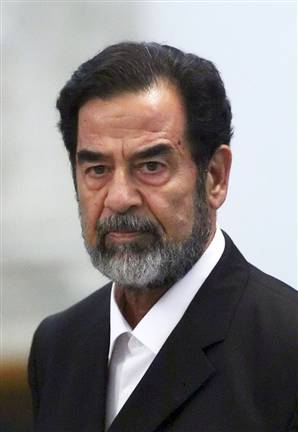
Clashes, celebratory gunfire greet guilty verdict; Talabani says trial was fair
BAGHDAD, Iraq - Iraq's High Tribunal on Sunday found Saddam Hussein guilty of crimes against humanity and sentenced him to hang for the 1982 killing of 148 Shiites in the city of Dujail. The visibly shaken former leader shouted "God is great!"
Saddam's half brother and former intelligence chief Barzan Ibrahim, and Awad Hamed al-Bandar, head of the former Revolutionary Court, were sentenced to join Saddam on the gallows for the Dujail killings after an unsuccessful assassination attempt during a Saddam visit to the city 35 miles north of Baghdad.
The death sentences automatically go to a nine-judge appeals panel which has unlimited time to review the case. If the verdicts and sentences are upheld, the executions must be carried out within 30 days.
Chief prosecutor Jaafar al-Moussawi told reporters that the Anfal trial now in progress for Saddam and others alleged role in gassing and killing Kurds would continue while the appeals process is underway. But if the appellate judges uphold the death sentence, the Anfal proceedings and other cases would be halted and Saddam hanged.
Al-Moussawi said Saddam would be hanged if the sentence were upheld, despite his demand that he be shot by a firing squad.
A court official told The Associated Press that the appeals process was likely to take three to four weeks once the formal paperwork was submitted.
Clashes, celebrationsClashes immediately broke out in north Baghdad's heavily Sunni Azamiyah district where police were battling men with machine guns. At least seven mortar shells slammed to earth around the Abu Hanifa mosque, the holiest Sunni shrine in the capital. There was no immediate word on casualties.
Celebratory gunfire rang out elsewhere in Baghdad, and the people in Sadr City, the capital's Shiite slum, celebrated in the streets, calling out "Where are you Saddam? We want to fight you."
Breathing heavily as he ran along the streets, 35-year-old Abu Sinan said, "This is an unprecedented feeling of happiness...nothing matches it, no festival nor marriage nor birth matches it. The verdict says Saddam must pay the price for murdering tens of thousands of Iraqis."
A jubilant crowd of young men carried pictures of radical anti-American Shiite cleric Muqtada al-Sadr and handed out candy to children.
In Tikrit, Saddam's hometown, 1,000 people defied the curfew and carried pictures of the city's favorite son through the streets.
Some declared the court a product of the U.S. "occupation forces" and decried the verdict.
"By our souls, by our blood we sacrifice for you Saddam" and "Saddam, your name shakes America."
People were celebrating in the streets of Dujail, a Tigris River city of 84,000, as the verdict was read. They burned pictures of their former tormentor.
Celebratory gunfire also rang out in Kurdish neighborhoods across the northern Iraqi city of Kirkuk, where taxi driver Khatab Ahmed sat on a mattress in his living room to watch trial coverage with his wife and six children.
"Thank God I lived to see the day when the criminals received their punishment," the 40-year-old exclaimed on hearing of Saddam's death sentence.
His brother and uncle were arrested by Saddam's security forces in the 1980s and disappeared forever. Two cousins died in a 1991 Kurdish uprising.
‘Trial was fair,’ Talabani says in ParisIraq’s president said Sunday that the trial against the ousted Iraqi leader was fair. But Jalal Talabani would not comment on the guilty verdict or death sentence for fear it could inflame tensions in his volatile nation.
“I think the trial was fair,” the president told The Associated Press at his Paris hotel, where he watched the proceedings live on television. “Those people had the full right to say what they intended.”
Talabani has opposed the death penalty in the past, but found a way around it by deputizing a vice president to sign an execution order on his behalf — a substitute that has been legally accepted.
Talabani, a Sunni Kurd who once took up arms against Saddam and was elected president in April 2005, would not comment Sunday about the use of the death penalty, saying he would make his position known after all the legal proceedings were exhausted.
“I must respect the independence of the Iraqi judiciary,” Talabani said. “Until the end I must be silent ... because my comments could affect the situation.”
Foreign Minister Hoshyar Zebari was more outspoken about the verdict.
“This was the only reasonable outcome,” he told AP, calling Sunday “a historic day” that would bring closure to Iraq’s relations with its former leader.
“It’s a victory for the victims of Saddam,” he said.
'An opportunity to unite'The United States Embassy immediately issued a statement under the name of Ambassador Zalmay Khalilzad, who said the verdicts "demonstrate the commitment of the Iraqi people to hold them (Saddam and his co-defendants) accountable."
"Although the Iraqis may face difficult days in the coming weeks, closing the book on Saddam and his regime is an opportunity to unite and build a better future," Khalilzad said.
Saddam's chief lawyer Khalil al-Dulaim told AP his client called on Iraqis to reject the sectarian violence ripping the country apart and to "not take revenge" on U.S. invaders.
"The message from President Saddam to his people came during a meeting in Baghdad this morning, just before the so-called Iraqi court issued its verdict in his trial," al-Dulaimi said.
British Foreign Secretary Margaret Beckett praised the verdict by an Iraqi court. “The evidence against him has been heard in full court, it has been tested in full court, and their verdict has been given in a court of the people against whom his crimes were committed,” she said.
After the verdict was read, a trembling Saddam yelled out, "Long live the people, and death to their enemies. Long live the glorious nation, and death to its enemies!"
Other verdicts followHe initially refused Chief Judge Raouf Adbul-Rahman's order to rise to hear the verdict and sentence. Two bailiffs lifted Saddam to his feet, and he remained standing but turned to one guard, telling him to stop twisting his arm.
Former Vice President and Saddam deputy Taha Yassin Ramadan was sentenced to life in prison.
Three defendants were sentenced to 15 years in prison for torture and premeditated murder. Abdullah Kazim Ruwayyid and his son Mizhar Abdullah Ruwayyid were party officials Dujail, along with Ali Dayih Ali. They were believed responsible for the Dujail arrests.
Mohammed Azawi Ali, a former Dujail Baath Party official, was acquitted for lack of evidence and immediately freed.
Before the trial began, one of Saddam's lawyers, former U.S. Attorney General Ramsey Clark, was ejected from the courtroom after handing the judge a memorandum in which he called the Saddam trial a "travesty."
Abdul-Rahman pointed to Clark and said in English, "Get out."
'A lot of incriminating evidence'The trial proceedings were shown on Iraqi and pan-Arab satellite television channels with a 20-minute delay. Ahead of the verdicts, several channels aired documentaries about Saddam's crackdowns on Kurds and Shiites. They also aired videotape of mass graves being uncovered after the U.S.-led invasion of Iraq in
Al-Masai television, run by the prominent Shiite Dawa party, played solemn music as it scrolled through snapshots of Iraqis who went missing under Saddam's 23-year rule.
Another Shiite channel, al-Furat, aired archive footage of Saddam from the 1980s proclaiming, "Everyone stands against the revolution, whether they are 100 or 2,000 or 10,000, I will chop their heads off and this doesn't shake a hair of me at all."
U.S. officials associated with the tribunal said Saddam's repeated courtroom outbursts during the nine-month trial may have played a key part in his conviction.
They cited his admission in a March 1 hearing that he had ordered the trial of 148 Shiites who were eventually executed, insisting that doing so was legal because they were suspected in an assassination attempt against him.
"Where is the crime? Where is the crime?" he asked, standing before the panel of five judges.
Damning decreeLater in the same session, he argued that his co-defendants must be released and that because he was in charge, he alone must be tried. His outburst came a day after the prosecution presented a presidential decree with a signature they said was Saddam's approving death sentences for the 148 Shiites, their most direct evidence against him.
About 50 of those sentenced by "The Revolutionary Court" died during interrogation before they could go to the gallows. Some of those hanged were juveniles.
"Every time they (defendants) rose and spoke, they provided a lot of incriminating evidence," said one of the U.S. officials, who spoke on condition of anonymity because of the sensitivity of the subject. "Saddam thought he had all the right answers, when in fact he was helping the court establish "command responsibility."
Under Saddam, Iraq's large bureaucracy showed consistent tendency to document government orders, policies and minutes of meetings. That, according to the U.S. officials, helped the prosecution produce more than 30 documents that clearly established the chain of command under Saddam.
One document gave the names of every one from Dujail banished to a desert detention camp in southern Iraq. Another, prepared by a close Saddam aide, gave the president a blow-by-blow account of the punitive measures taken against the people of Dujail following the failed attempt on Saddam's life.
Trial mirrored turmoil of IraqSaddam's trial had from the outset appeared to reflect the turmoil and violence prevailing in Iraq since the 2003 U.S.-led invasion toppled the former president.
One of Saddam's lawyers was assassinated the day after the trial's opening session on Oct. 19, last year. Two more were later assassinated and a fourth one fled the country.
In January, chief judge Rizgar Amin, a Kurd, resigned after complaints by Shiite politicians that he had failed to keep control of court proceedings. He, in turn, complained of political interference in the trial. Another Kurd, Raouf Abdul-Rahman, replaced Amin.
Hearings were frequently disrupted by outbursts from Saddam and Ibrahim, with the two raging against what they said was the illegitimacy of the court, their bad treatment in the U.S.-run facility where they are being held and the lack of protection of their defense attorneys.
The defense lawyers contributed to the chaos in the courtroom by staging several boycotts.
© 2006 The Associated Press.
BAGHDAD, Iraq - Iraq's High Tribunal on Sunday found Saddam Hussein guilty of crimes against humanity and sentenced him to hang for the 1982 killing of 148 Shiites in the city of Dujail. The visibly shaken former leader shouted "God is great!"
Saddam's half brother and former intelligence chief Barzan Ibrahim, and Awad Hamed al-Bandar, head of the former Revolutionary Court, were sentenced to join Saddam on the gallows for the Dujail killings after an unsuccessful assassination attempt during a Saddam visit to the city 35 miles north of Baghdad.
The death sentences automatically go to a nine-judge appeals panel which has unlimited time to review the case. If the verdicts and sentences are upheld, the executions must be carried out within 30 days.
Chief prosecutor Jaafar al-Moussawi told reporters that the Anfal trial now in progress for Saddam and others alleged role in gassing and killing Kurds would continue while the appeals process is underway. But if the appellate judges uphold the death sentence, the Anfal proceedings and other cases would be halted and Saddam hanged.
Al-Moussawi said Saddam would be hanged if the sentence were upheld, despite his demand that he be shot by a firing squad.
A court official told The Associated Press that the appeals process was likely to take three to four weeks once the formal paperwork was submitted.
Clashes, celebrationsClashes immediately broke out in north Baghdad's heavily Sunni Azamiyah district where police were battling men with machine guns. At least seven mortar shells slammed to earth around the Abu Hanifa mosque, the holiest Sunni shrine in the capital. There was no immediate word on casualties.
Celebratory gunfire rang out elsewhere in Baghdad, and the people in Sadr City, the capital's Shiite slum, celebrated in the streets, calling out "Where are you Saddam? We want to fight you."
Breathing heavily as he ran along the streets, 35-year-old Abu Sinan said, "This is an unprecedented feeling of happiness...nothing matches it, no festival nor marriage nor birth matches it. The verdict says Saddam must pay the price for murdering tens of thousands of Iraqis."
A jubilant crowd of young men carried pictures of radical anti-American Shiite cleric Muqtada al-Sadr and handed out candy to children.
In Tikrit, Saddam's hometown, 1,000 people defied the curfew and carried pictures of the city's favorite son through the streets.
Some declared the court a product of the U.S. "occupation forces" and decried the verdict.
"By our souls, by our blood we sacrifice for you Saddam" and "Saddam, your name shakes America."
People were celebrating in the streets of Dujail, a Tigris River city of 84,000, as the verdict was read. They burned pictures of their former tormentor.
Celebratory gunfire also rang out in Kurdish neighborhoods across the northern Iraqi city of Kirkuk, where taxi driver Khatab Ahmed sat on a mattress in his living room to watch trial coverage with his wife and six children.
"Thank God I lived to see the day when the criminals received their punishment," the 40-year-old exclaimed on hearing of Saddam's death sentence.
His brother and uncle were arrested by Saddam's security forces in the 1980s and disappeared forever. Two cousins died in a 1991 Kurdish uprising.
‘Trial was fair,’ Talabani says in ParisIraq’s president said Sunday that the trial against the ousted Iraqi leader was fair. But Jalal Talabani would not comment on the guilty verdict or death sentence for fear it could inflame tensions in his volatile nation.
“I think the trial was fair,” the president told The Associated Press at his Paris hotel, where he watched the proceedings live on television. “Those people had the full right to say what they intended.”
Talabani has opposed the death penalty in the past, but found a way around it by deputizing a vice president to sign an execution order on his behalf — a substitute that has been legally accepted.
Talabani, a Sunni Kurd who once took up arms against Saddam and was elected president in April 2005, would not comment Sunday about the use of the death penalty, saying he would make his position known after all the legal proceedings were exhausted.
“I must respect the independence of the Iraqi judiciary,” Talabani said. “Until the end I must be silent ... because my comments could affect the situation.”
Foreign Minister Hoshyar Zebari was more outspoken about the verdict.
“This was the only reasonable outcome,” he told AP, calling Sunday “a historic day” that would bring closure to Iraq’s relations with its former leader.
“It’s a victory for the victims of Saddam,” he said.
'An opportunity to unite'The United States Embassy immediately issued a statement under the name of Ambassador Zalmay Khalilzad, who said the verdicts "demonstrate the commitment of the Iraqi people to hold them (Saddam and his co-defendants) accountable."
"Although the Iraqis may face difficult days in the coming weeks, closing the book on Saddam and his regime is an opportunity to unite and build a better future," Khalilzad said.
Saddam's chief lawyer Khalil al-Dulaim told AP his client called on Iraqis to reject the sectarian violence ripping the country apart and to "not take revenge" on U.S. invaders.
"The message from President Saddam to his people came during a meeting in Baghdad this morning, just before the so-called Iraqi court issued its verdict in his trial," al-Dulaimi said.
British Foreign Secretary Margaret Beckett praised the verdict by an Iraqi court. “The evidence against him has been heard in full court, it has been tested in full court, and their verdict has been given in a court of the people against whom his crimes were committed,” she said.
After the verdict was read, a trembling Saddam yelled out, "Long live the people, and death to their enemies. Long live the glorious nation, and death to its enemies!"
Other verdicts followHe initially refused Chief Judge Raouf Adbul-Rahman's order to rise to hear the verdict and sentence. Two bailiffs lifted Saddam to his feet, and he remained standing but turned to one guard, telling him to stop twisting his arm.
Former Vice President and Saddam deputy Taha Yassin Ramadan was sentenced to life in prison.
Three defendants were sentenced to 15 years in prison for torture and premeditated murder. Abdullah Kazim Ruwayyid and his son Mizhar Abdullah Ruwayyid were party officials Dujail, along with Ali Dayih Ali. They were believed responsible for the Dujail arrests.
Mohammed Azawi Ali, a former Dujail Baath Party official, was acquitted for lack of evidence and immediately freed.
Before the trial began, one of Saddam's lawyers, former U.S. Attorney General Ramsey Clark, was ejected from the courtroom after handing the judge a memorandum in which he called the Saddam trial a "travesty."
Abdul-Rahman pointed to Clark and said in English, "Get out."
'A lot of incriminating evidence'The trial proceedings were shown on Iraqi and pan-Arab satellite television channels with a 20-minute delay. Ahead of the verdicts, several channels aired documentaries about Saddam's crackdowns on Kurds and Shiites. They also aired videotape of mass graves being uncovered after the U.S.-led invasion of Iraq in
Al-Masai television, run by the prominent Shiite Dawa party, played solemn music as it scrolled through snapshots of Iraqis who went missing under Saddam's 23-year rule.
Another Shiite channel, al-Furat, aired archive footage of Saddam from the 1980s proclaiming, "Everyone stands against the revolution, whether they are 100 or 2,000 or 10,000, I will chop their heads off and this doesn't shake a hair of me at all."
U.S. officials associated with the tribunal said Saddam's repeated courtroom outbursts during the nine-month trial may have played a key part in his conviction.
They cited his admission in a March 1 hearing that he had ordered the trial of 148 Shiites who were eventually executed, insisting that doing so was legal because they were suspected in an assassination attempt against him.
"Where is the crime? Where is the crime?" he asked, standing before the panel of five judges.
Damning decreeLater in the same session, he argued that his co-defendants must be released and that because he was in charge, he alone must be tried. His outburst came a day after the prosecution presented a presidential decree with a signature they said was Saddam's approving death sentences for the 148 Shiites, their most direct evidence against him.
About 50 of those sentenced by "The Revolutionary Court" died during interrogation before they could go to the gallows. Some of those hanged were juveniles.
"Every time they (defendants) rose and spoke, they provided a lot of incriminating evidence," said one of the U.S. officials, who spoke on condition of anonymity because of the sensitivity of the subject. "Saddam thought he had all the right answers, when in fact he was helping the court establish "command responsibility."
Under Saddam, Iraq's large bureaucracy showed consistent tendency to document government orders, policies and minutes of meetings. That, according to the U.S. officials, helped the prosecution produce more than 30 documents that clearly established the chain of command under Saddam.
One document gave the names of every one from Dujail banished to a desert detention camp in southern Iraq. Another, prepared by a close Saddam aide, gave the president a blow-by-blow account of the punitive measures taken against the people of Dujail following the failed attempt on Saddam's life.
Trial mirrored turmoil of IraqSaddam's trial had from the outset appeared to reflect the turmoil and violence prevailing in Iraq since the 2003 U.S.-led invasion toppled the former president.
One of Saddam's lawyers was assassinated the day after the trial's opening session on Oct. 19, last year. Two more were later assassinated and a fourth one fled the country.
In January, chief judge Rizgar Amin, a Kurd, resigned after complaints by Shiite politicians that he had failed to keep control of court proceedings. He, in turn, complained of political interference in the trial. Another Kurd, Raouf Abdul-Rahman, replaced Amin.
Hearings were frequently disrupted by outbursts from Saddam and Ibrahim, with the two raging against what they said was the illegitimacy of the court, their bad treatment in the U.S.-run facility where they are being held and the lack of protection of their defense attorneys.
The defense lawyers contributed to the chaos in the courtroom by staging several boycotts.
© 2006 The Associated Press.
Wednesday, November 01, 2006
7-9 Shot In Castro's Hallowe'en - 2006
Good thing, I guess, that I didn't take Jonah to to this annual event:
Violence marred the annual Halloween celebration in San Francisco's Castro district Tuesday when seven people were shot in the 2200 block of Market Street just as the event was drawing to an end, police said.
The shooting occurred near Sullivan's Funeral Chapel about a block away from the main stage of the party that drew thousands of revelers, police said.
Police heard the shots and ran toward 2255 Market to find two women and five men on the ground, two with life-threatening injuries. One suffered a gunshot to the head. The victims were transported to San Francisco General Hospital. The other five suffered nonlife-threatening injuries. Police also said they received reports of at least one stabbing and one report of a possible sexual assault.
The gunfire erupted at 10:40 p.m., about 10 minutes after the techno music ended and police began making announcements over a loudspeaker that it was time to leave. Fearing violence and unruly crowds, this year city leaders for the first time imposed an 11 p.m. curfew on the event.
"We believe the shooting happened in an area that was cordoned off so someone might have snuck a gun inside," said Sgt. Neville Gittens.
Police detained two people for questioning, who could be witnesses or suspects.
San Francisco Supervisor Bevan Dufty, who represents the city's gay mecca and surrounding neighborhoods, had said earlier in the day that he and other leaders hoped to phase out the annual gathering, which drew nearly 300,000 people last year -- too big, he said, for the merchants and residents to bear.
Before the violence broke, people were enjoying the festivities, standing shoulder to shoulder in a big throng that included mermaids, monsters and many men sans their shirts at Market and Castro streets.
"This is tragic," Dufty said. "I'm disappointed. All along we've been concerned about an increase in the climate of violence, especially among juveniles." He said his information was that all the victims were young.
Dufty had said the objective of Castro leaders was to encourage people to visit the district, but to end their nights at bars or clubs in their hometowns or in other San Francisco neighborhoods. By his own estimation, only 10 percent of those at the Halloween party are from the neighborhood.
"There's not a lot of support for this annual even in the community," Dufty said. "And now this really begs the question, who are we doing this for?"
This year the police presence in the Castro was increased by 25 percent, the performance stages were reduced from three to one, and officials announced an increased effort to cite public drunks and illegal parkers.
Seven people had been arrested for public drunkenness -- and that had been the only trouble up until the shootings. Police successfully used an air raid siren to disperse the crowd, and the city's Department of Public Works followed with street sweepers.
"I just think this is a transitional year for Halloween in the Castro," Dufty said Tuesday evening before the violence and after taking his daughter in a pumpkin costume to 24th Street in Noe Valley for the city's kid version of Castro Street.
The annual event has had violence in the past -- but nothing as serious as the shootings of seven people.
Some residents avoided the night altogether and came out in costume on "secret" Saturday night instead.
"I've come the last few years and the crowds are overwhelming," said Jon Ivan Weaver, who affixed crows and fake blood to his clothes and showed up both Saturday and Tuesday dressed as Tippi Hedren in the movie "The Birds." "Something has to be done."
The gathering, which began in the 1960s, took a negative turn in 2002 when four people were stabbed, 30 people were arrested and police were pelted with bottles. Ever since, city officials have been trying to make it safer, adding security gates and screening for dangerous items, a ban on public alcohol consumption and a lane reserved for emergency vehicles.
The rumor in Karen Santos' Butte County hometown of Oroville was that this was the last year for the Castro Halloween party. She hadn't attended in more than a decade, after she moved away from the neighborhood, but she rallied her boyfriend and showed up at 5:30 p.m. dressed as the late "queen of Tejano music," singer Selena.
"I'm staying until the party is over," said Santos, 40. "If the party is still going after 11, I'm sticking around."
Mayor Gavin Newsom, who endorses the quieter, gentler Halloween plan, walked the street with his aides and police escorts around 6 p.m., moving briskly through the crowd.
If Angel Pasillas of San Leandro, dressed as Al Pacino's Scarface, could have gotten some face time with Newsom, he would have told him that watering down Halloween is like taking the Mardi Gras out of New Orleans. Usually, Pasillas drives his car to the Castro on Halloween and stays out until 4 a.m. This time, he took BART, and planned to leave once the crowds thin out.
"We should be happy to hold events like this," he said. "I don't appreciate the changes."
Halloween in the Castro has become a central issue in Dufty's Nov. 7 re-election campaign. His main challenger, Alix Rosenthal, has said Dufty is slowly draining the fun out of the neighborhood.
She said the shootings were a result of poor planning on the part of the city.
"This event was planned way too late in the game," she said. "The police have done a great job, but they can't do it alone. The city needed to have dedicated more resources. It's really sad what happened tonight."
She added that it's silly and unrealistic to assume a spontaneous gathering can be shut down by city officials at their desired hour.
Paul Ellis, 49, isn't so sure. As a 22-year resident of the Castro and a manager at Cliff's Variety store, he understands the power of tradition but feels the strain of the Halloween invasion.
"I don't want to lose this thing that so many people enjoy so much," said Ellis, who dressed in colorful silks as an Arabian sultan. "But this is a residential neighborhood. It's not meant to hold this many people."
E-mail the writers at mmay@sfchronicle.com,
11-01) 15:35 PST SAN FRANCISCO -- As police today pieced together what led to a shooting that injured nine people at the Castro Halloween celebration, city officials were talking about whether the party should be over for good.
"When you have a historic event, you can't just stop them, because people will still show up," San Francisco Mayor Gavin Newsom said today.
Still, he said that is an option city officials are considering.
As Newsom, talking to reporters, laid out options -- collecting an entry fee, setting an age requirement, using metal detectors -- he echoed the sentiments of many San Franciscans
"Thank God no one was killed," he said. "That probably would have ended the event immediately, and that does not mean we will not consider shutting this even down in the future."
Police say that the Tuesday night shooting was sparked by a bottle being thrown at someone.
They questioned one person in connection with the 10:40 p.m. incident, but that person has since been released. No arrests have been made.
The altercation involved two groups of young people, ages 15 to 25, officials said. At least one of the groups was from San Francisco, police said.
After someone threw a bottle, hitting someone in the other group, a person in the second group opened fire, shooting as many as nine times, police said.
San Francisco police believe at least one gang was involved in the shooting, which is being investigated by the department's gang task force.
Nine people were shot, but police said only two were taken by ambulance to San Francisco General Hospital: a woman whose head was grazed by a bullet and a second victim who was hit in the knee.
Several others were treated at the scene, including a woman who was not shot but injured when she was trampled by the crowd.
Supervisor Bevan Dufty, whose district includes the Castro neighborhood, said two additional shooting victims took themselves to Kaiser Hospital in South San Francisco and another brought himself to General Hospital for treatment.
He described the victims, including the one who was trampled, as eight men and two women, all in their teens or early 20s. All are expected to recover, he said.
City officials and residents today were talking about how to handle the raucous event next year.
Said Dufty: "Everything is on the table right now.
"The sad part of this is that the city really stepped it up and rose to the occasion and did everything we could do make it safe," he said.
Dufty and Newsom are meeting this afternoon to discuss the matter, and the mayor said he also has been speaking with Police Chief Heather Fong.
The gunfire erupted about 10 minutes after the techno music had ended and police had begun making announcements over a loudspeaker that it was time to leave the party, which this year was given an 11 p.m. curfew.
The gathering, which has been going on for decades, attracted the city's attention in 2002, when four people were stabbed. Since then, alcohol has been banned and there has been talk of canceling the party altogether.
This year, officials reined in the event even further, increasing police presence by 25 percent, setting an 11 p.m. curfew and limiting entertainment from three stages to one.
More than 500 police officers and 100 sheriff's deputies staffed the entry gates with instructions to search people's bags for alcohol and weapons before allowing them into the cordoned-off blocks. But today, many attendees said the searches were intermittent at best.
"Somehow, someone slipped in with a weapon," Newsom said. "The question is what we could have done differently. We're going to analyze that."
Dufty said this morning that police and city departments involved in the event did "an incredible job.
"Can you imagine if this was an event we weren't curtailing, what violence could have been if people were still out at midnight or 1 a.m.?" he said. "People who stopped me on the streets this morning said, 'This is what I have been fearful for.' ... It was a very young crowd ... with some menacing elements."
Castro residents had mixed reactions about the event this morning: Several said it should be canceled, while others said it didn't appear the police had done a good enough job checking attendees for weapons.
Neighborhood resident Stephen Chien said he exited the Castro Muni Station at 8:30 p.m. on his way home from work and saw "absolutely no weapons check." Nob Hill resident Monica Green said she entered the area around 9 p.m. at 18th and Castro streets and also did not see police checking anyone.
"I was standing in line, in the crush to get through the barricades, and a young guy was standing next to me with his girlfriend and a couple of friends," she said. "He pulled out a (box cutter) and I thought, 'Oh my God.' He asked his girlfriend to hide it, and she stuck it down her shirt."
Green said she told a policeman about the knife and he "simply shrugged," then asked a fellow officer to search Green's bag.
Alix Rosenthal, an Oakland attorney who is looking to unseat Dufty in next week's election, today used the shooting as an opportunity to criticize her opponent.
In a press release, she said she planned to call for a public hearing "regarding mismanagement of (the) Halloween event and the resulting violence."
Rosenthal said Dufty "botched" his handling of the event and criticized the city's plan to shut down the party early. She accused Dufty of planning the event single-handedly and said she never supported the effort to "eradicate" it.
"This plan was a recipe for disaster," she said.
Earlier, Dufty said he had worked with police, fire and other city departments to plan the event, and indicated he expected Rosenthal to criticize him.
"I have stood up and taken responsibility for this event for four years," he said.
E-mail the writers at mlagos@sfchronicle.com,
Violence marred the annual Halloween celebration in San Francisco's Castro district Tuesday when seven people were shot in the 2200 block of Market Street just as the event was drawing to an end, police said.
The shooting occurred near Sullivan's Funeral Chapel about a block away from the main stage of the party that drew thousands of revelers, police said.
Police heard the shots and ran toward 2255 Market to find two women and five men on the ground, two with life-threatening injuries. One suffered a gunshot to the head. The victims were transported to San Francisco General Hospital. The other five suffered nonlife-threatening injuries. Police also said they received reports of at least one stabbing and one report of a possible sexual assault.
The gunfire erupted at 10:40 p.m., about 10 minutes after the techno music ended and police began making announcements over a loudspeaker that it was time to leave. Fearing violence and unruly crowds, this year city leaders for the first time imposed an 11 p.m. curfew on the event.
"We believe the shooting happened in an area that was cordoned off so someone might have snuck a gun inside," said Sgt. Neville Gittens.
Police detained two people for questioning, who could be witnesses or suspects.
San Francisco Supervisor Bevan Dufty, who represents the city's gay mecca and surrounding neighborhoods, had said earlier in the day that he and other leaders hoped to phase out the annual gathering, which drew nearly 300,000 people last year -- too big, he said, for the merchants and residents to bear.
Before the violence broke, people were enjoying the festivities, standing shoulder to shoulder in a big throng that included mermaids, monsters and many men sans their shirts at Market and Castro streets.
"This is tragic," Dufty said. "I'm disappointed. All along we've been concerned about an increase in the climate of violence, especially among juveniles." He said his information was that all the victims were young.
Dufty had said the objective of Castro leaders was to encourage people to visit the district, but to end their nights at bars or clubs in their hometowns or in other San Francisco neighborhoods. By his own estimation, only 10 percent of those at the Halloween party are from the neighborhood.
"There's not a lot of support for this annual even in the community," Dufty said. "And now this really begs the question, who are we doing this for?"
This year the police presence in the Castro was increased by 25 percent, the performance stages were reduced from three to one, and officials announced an increased effort to cite public drunks and illegal parkers.
Seven people had been arrested for public drunkenness -- and that had been the only trouble up until the shootings. Police successfully used an air raid siren to disperse the crowd, and the city's Department of Public Works followed with street sweepers.
"I just think this is a transitional year for Halloween in the Castro," Dufty said Tuesday evening before the violence and after taking his daughter in a pumpkin costume to 24th Street in Noe Valley for the city's kid version of Castro Street.
The annual event has had violence in the past -- but nothing as serious as the shootings of seven people.
Some residents avoided the night altogether and came out in costume on "secret" Saturday night instead.
"I've come the last few years and the crowds are overwhelming," said Jon Ivan Weaver, who affixed crows and fake blood to his clothes and showed up both Saturday and Tuesday dressed as Tippi Hedren in the movie "The Birds." "Something has to be done."
The gathering, which began in the 1960s, took a negative turn in 2002 when four people were stabbed, 30 people were arrested and police were pelted with bottles. Ever since, city officials have been trying to make it safer, adding security gates and screening for dangerous items, a ban on public alcohol consumption and a lane reserved for emergency vehicles.
The rumor in Karen Santos' Butte County hometown of Oroville was that this was the last year for the Castro Halloween party. She hadn't attended in more than a decade, after she moved away from the neighborhood, but she rallied her boyfriend and showed up at 5:30 p.m. dressed as the late "queen of Tejano music," singer Selena.
"I'm staying until the party is over," said Santos, 40. "If the party is still going after 11, I'm sticking around."
Mayor Gavin Newsom, who endorses the quieter, gentler Halloween plan, walked the street with his aides and police escorts around 6 p.m., moving briskly through the crowd.
If Angel Pasillas of San Leandro, dressed as Al Pacino's Scarface, could have gotten some face time with Newsom, he would have told him that watering down Halloween is like taking the Mardi Gras out of New Orleans. Usually, Pasillas drives his car to the Castro on Halloween and stays out until 4 a.m. This time, he took BART, and planned to leave once the crowds thin out.
"We should be happy to hold events like this," he said. "I don't appreciate the changes."
Halloween in the Castro has become a central issue in Dufty's Nov. 7 re-election campaign. His main challenger, Alix Rosenthal, has said Dufty is slowly draining the fun out of the neighborhood.
She said the shootings were a result of poor planning on the part of the city.
"This event was planned way too late in the game," she said. "The police have done a great job, but they can't do it alone. The city needed to have dedicated more resources. It's really sad what happened tonight."
She added that it's silly and unrealistic to assume a spontaneous gathering can be shut down by city officials at their desired hour.
Paul Ellis, 49, isn't so sure. As a 22-year resident of the Castro and a manager at Cliff's Variety store, he understands the power of tradition but feels the strain of the Halloween invasion.
"I don't want to lose this thing that so many people enjoy so much," said Ellis, who dressed in colorful silks as an Arabian sultan. "But this is a residential neighborhood. It's not meant to hold this many people."
E-mail the writers at mmay@sfchronicle.com,
11-01) 15:35 PST SAN FRANCISCO -- As police today pieced together what led to a shooting that injured nine people at the Castro Halloween celebration, city officials were talking about whether the party should be over for good.
"When you have a historic event, you can't just stop them, because people will still show up," San Francisco Mayor Gavin Newsom said today.
Still, he said that is an option city officials are considering.
As Newsom, talking to reporters, laid out options -- collecting an entry fee, setting an age requirement, using metal detectors -- he echoed the sentiments of many San Franciscans
"Thank God no one was killed," he said. "That probably would have ended the event immediately, and that does not mean we will not consider shutting this even down in the future."
Police say that the Tuesday night shooting was sparked by a bottle being thrown at someone.
They questioned one person in connection with the 10:40 p.m. incident, but that person has since been released. No arrests have been made.
The altercation involved two groups of young people, ages 15 to 25, officials said. At least one of the groups was from San Francisco, police said.
After someone threw a bottle, hitting someone in the other group, a person in the second group opened fire, shooting as many as nine times, police said.
San Francisco police believe at least one gang was involved in the shooting, which is being investigated by the department's gang task force.
Nine people were shot, but police said only two were taken by ambulance to San Francisco General Hospital: a woman whose head was grazed by a bullet and a second victim who was hit in the knee.
Several others were treated at the scene, including a woman who was not shot but injured when she was trampled by the crowd.
Supervisor Bevan Dufty, whose district includes the Castro neighborhood, said two additional shooting victims took themselves to Kaiser Hospital in South San Francisco and another brought himself to General Hospital for treatment.
He described the victims, including the one who was trampled, as eight men and two women, all in their teens or early 20s. All are expected to recover, he said.
City officials and residents today were talking about how to handle the raucous event next year.
Said Dufty: "Everything is on the table right now.
"The sad part of this is that the city really stepped it up and rose to the occasion and did everything we could do make it safe," he said.
Dufty and Newsom are meeting this afternoon to discuss the matter, and the mayor said he also has been speaking with Police Chief Heather Fong.
The gunfire erupted about 10 minutes after the techno music had ended and police had begun making announcements over a loudspeaker that it was time to leave the party, which this year was given an 11 p.m. curfew.
The gathering, which has been going on for decades, attracted the city's attention in 2002, when four people were stabbed. Since then, alcohol has been banned and there has been talk of canceling the party altogether.
This year, officials reined in the event even further, increasing police presence by 25 percent, setting an 11 p.m. curfew and limiting entertainment from three stages to one.
More than 500 police officers and 100 sheriff's deputies staffed the entry gates with instructions to search people's bags for alcohol and weapons before allowing them into the cordoned-off blocks. But today, many attendees said the searches were intermittent at best.
"Somehow, someone slipped in with a weapon," Newsom said. "The question is what we could have done differently. We're going to analyze that."
Dufty said this morning that police and city departments involved in the event did "an incredible job.
"Can you imagine if this was an event we weren't curtailing, what violence could have been if people were still out at midnight or 1 a.m.?" he said. "People who stopped me on the streets this morning said, 'This is what I have been fearful for.' ... It was a very young crowd ... with some menacing elements."
Castro residents had mixed reactions about the event this morning: Several said it should be canceled, while others said it didn't appear the police had done a good enough job checking attendees for weapons.
Neighborhood resident Stephen Chien said he exited the Castro Muni Station at 8:30 p.m. on his way home from work and saw "absolutely no weapons check." Nob Hill resident Monica Green said she entered the area around 9 p.m. at 18th and Castro streets and also did not see police checking anyone.
"I was standing in line, in the crush to get through the barricades, and a young guy was standing next to me with his girlfriend and a couple of friends," she said. "He pulled out a (box cutter) and I thought, 'Oh my God.' He asked his girlfriend to hide it, and she stuck it down her shirt."
Green said she told a policeman about the knife and he "simply shrugged," then asked a fellow officer to search Green's bag.
Alix Rosenthal, an Oakland attorney who is looking to unseat Dufty in next week's election, today used the shooting as an opportunity to criticize her opponent.
In a press release, she said she planned to call for a public hearing "regarding mismanagement of (the) Halloween event and the resulting violence."
Rosenthal said Dufty "botched" his handling of the event and criticized the city's plan to shut down the party early. She accused Dufty of planning the event single-handedly and said she never supported the effort to "eradicate" it.
"This plan was a recipe for disaster," she said.
Earlier, Dufty said he had worked with police, fire and other city departments to plan the event, and indicated he expected Rosenthal to criticize him.
"I have stood up and taken responsibility for this event for four years," he said.
E-mail the writers at mlagos@sfchronicle.com,
Friday, October 27, 2006
British twins have different skin color

LONDON - A pair of British twin boys has been born with different skin color, a rare genetic occurrence according to experts.
In an interview with Britain's Sky News program, mother Kerry Richardson said that the boys were both born white but as they've gotten older one of the boys got darker and the other lighter.
Today, she says, the twins attract attention wherever they go.
In an interview with Britain's Sky News program, mother Kerry Richardson said that the boys were both born white but as they've gotten older one of the boys got darker and the other lighter.
Today, she says, the twins attract attention wherever they go.
Richardson is of mixed race, with Nigerian and English heritage, while the father is white.
A genetics expert at Oxford University says such births are rare, as the genes that cause skin color normally mix together. In this case, he says, it appears the genes for skin color didn't combine for some reason and the boys may have inherited different genetic codes from their mother.
A genetics expert at Oxford University says such births are rare, as the genes that cause skin color normally mix together. In this case, he says, it appears the genes for skin color didn't combine for some reason and the boys may have inherited different genetic codes from their mother.
Thursday, October 26, 2006
GAY MARRAIGE: New Jersey
New Jersey's Supreme Court passed the buck onto the State Legislature on the “gay-marriage” issue. While doing this they have made some strong statements and directives to the legislature about same-sex unions. The Supreme Court has decided that same-sex couples should be given all of the rights as those in a heterosexual marriage. It has given the lawmakers six months time to alter the current law on this subject.The directive from the Supreme Court to the Legislature is to alter the marriage law to include same-sex couples or create a premise like a civil union that provides all the rights and benefits that a marriage grants. This includes a lot of those privileges that are taken for granted in a marriage and which are not available for these couples now. These include receiving benefits from the state when a partner dies, tax deductions for medical expenses of the spouse and no fees when partners transfer real estate between themselves. The rights that are being fought include parental rights, which are given in a marriage to a spouse even if there are not biological parents. These will cause all the laws regarding children to come into play, in a same-sex union, like child support, custody issues and support after separation. Court's decision seems to be in the direction of a giant step toward “equality”.
The current law that is in place for same-sex couples has limited benefits like hospital visitation, a few tax benefits and guardianship only in the case a partner is disabled. It does not provide health benefits from an employer and also the right to change surnames. If one partner wants to change the surname it has to be done through the court. Moreover gaining legal recognition is a big issue for same-sex couples unlike heterosexual couples who could marry to gain it. On a nationwide basis only Massachusetts has legalized gay marriage. Vermont, Connecticut and California have provided same rights as marriage if not the title of marriage. The federal government of USA does not acknowledge same-sex marriages or unions and hence these couples are not entitled to any federal benefits like those in a heterosexual marriage. In nineteen states of the US same-sex marriage is banned. These are the statistics on the gay marriage/union issue in the US. So in the wake of New Jersey's Supreme Court's decision gay and lesbian right activists and lawyers would fight for the tile “marriage”, some others for equal rights and others for a complete ban on same-sex marriages/unions.
The current law that is in place for same-sex couples has limited benefits like hospital visitation, a few tax benefits and guardianship only in the case a partner is disabled. It does not provide health benefits from an employer and also the right to change surnames. If one partner wants to change the surname it has to be done through the court. Moreover gaining legal recognition is a big issue for same-sex couples unlike heterosexual couples who could marry to gain it. On a nationwide basis only Massachusetts has legalized gay marriage. Vermont, Connecticut and California have provided same rights as marriage if not the title of marriage. The federal government of USA does not acknowledge same-sex marriages or unions and hence these couples are not entitled to any federal benefits like those in a heterosexual marriage. In nineteen states of the US same-sex marriage is banned. These are the statistics on the gay marriage/union issue in the US. So in the wake of New Jersey's Supreme Court's decision gay and lesbian right activists and lawyers would fight for the tile “marriage”, some others for equal rights and others for a complete ban on same-sex marriages/unions.
Saturday, October 21, 2006
Inmate Refuses to Leave Gaol
BERLIN - A 59-year-old German man who has spent the last 34 years in jail has turned down offers to be let out, an official said Saturday.
"He rejected an offer to leave in 1992," Thomas Melzer, a spokesman for the Brandenburg state justice ministry, told Bild newspaper. "We can't do anything if someone sentenced to life in prison doesn't want to leave."
The man, identified only as Gerold H., was convicted of murder and sentenced to life imprisonment in 1972 when the area was part of communist East Germany.
German prisoners have no obligation to agree to leave jail before their sentences have been completed.
"He rejected an offer to leave in 1992," Thomas Melzer, a spokesman for the Brandenburg state justice ministry, told Bild newspaper. "We can't do anything if someone sentenced to life in prison doesn't want to leave."
The man, identified only as Gerold H., was convicted of murder and sentenced to life imprisonment in 1972 when the area was part of communist East Germany.
German prisoners have no obligation to agree to leave jail before their sentences have been completed.
Friday, October 20, 2006
Bush Compares Iraq War to Vietnam
Bush links Iraq to Vietnam as operation to halt violence fails
By Rupert Cornwell in Washington
Published: 20 October 2006
As President Bush drew parallels between Iraq and Vietnam for the first time, American commanders publicly admitted yesterday that a two-month campaign by US and Iraqi forces to end the violence in Baghdad had to all intents and purposes failed.
The grim assessment, by Major General William B Caldwell, the military spokesman, came as at least 38 Iraqis were killed in bombings in the north of the country and the Pentagon announced that two more American soldiers had been killed on Wednesday, following 11 losses the previous day. October is shaping up as the deadliest month for US troops in Iraq in almost two years and the overall death toll since the March 2003 invasion now approaches 2,800.
The Baghdad security crackdown, announced amid much fanfare in August, "did not meet our overall expectations," and the latest surge in violence, over Ramadan, had been "disheartening" according to Maj Gen Caldwell. Security efforts in Baghdad were now being "refocused". He also explicitly linked the attacks with next month's mid-term elections in the US, where Mr Bush's Republicans are facing heavy losses.
The President acknowledged in a TV interview with ABC News that, "it could be right" to say the violence in Iraq was the equivalent of the 1968 Tet Offensive, which helped turned US public opinion against the Vietnam war.
"There's certainly a stepped-up level of violence," the Mr Bush said, "and we're heading into an election."
Yesterday the White House was playing down the remarks, stressing the President did not mean to imply that a similar turning point in the Iraq war had arrived.
"We don't think that there's been a flip-over point," Tony Snow, the White House spokesman, said. "From ... the standpoint of this administration, we're going to continue pursuing victory aggressively."
The allusion to the Tet Offensive was a real departure for Mr Bush, who hitherto refused to accept any similarities between Iraq and the war in Vietnam, which lasted eight years and claimed more than 55,000 American lives.
The conflict in Iraqhas become an albatross around Republican candidates' necks as they struggle to retain control of Congress in the 7 November elections. An unprecedented 35 per cent of registered voters plan to express their opposition to Mr Bush, against just 18 per cent who said they would be voting to support the President.
Some Republicans are joining calls from the Demo-crats for a phased withdrawal from Iraq and the idea is being examined by the Iraq Study Group, a bi-partisan commission headed by the former Secretary of State James Baker which is due to report at the end of the year.
Donald Rumsfeld, the Defence Secretary, has prom-ised a reduction in American forces, "in the months ahead". But Mr Bush told ABC that some of the 145,000 US troops in Iraq would still be there when he left office in January 2009.
Complicating matters is the evident tension between Washington and the Iraqi government under Nouri al-Maliki, whose failure to restore security has been the object of growing criticism in the US - so much so that the Iraqi Prime Minister sought reassurances last week from Mr Bush that the US was not pulling the rug out from under his government.
According to Maj Gen Caldwell, US troops had been forced this week to release Mazin al-Sa'edi, a senior lieutenant of the radical Shia cleric Muqtada al-Sadr, only a day after he had been taken into custody on suspicion of "illegal" activities. The demand that he be freed had come from Mr Maliki, the US spokesman said. A further source of friction is a partial amnesty sought by US officials.
"There's going to end up being an amnesty," Mr Rumsfeld said, "not for people with blood on their hands, but for those who opposed the government." After initial enthusiasm, the Maliki government has been dragging its feet on the issue.
As President Bush drew parallels between Iraq and Vietnam for the first time, American commanders publicly admitted yesterday that a two-month campaign by US and Iraqi forces to end the violence in Baghdad had to all intents and purposes failed.
The grim assessment, by Major General William B Caldwell, the military spokesman, came as at least 38 Iraqis were killed in bombings in the north of the country and the Pentagon announced that two more American soldiers had been killed on Wednesday, following 11 losses the previous day. October is shaping up as the deadliest month for US troops in Iraq in almost two years and the overall death toll since the March 2003 invasion now approaches 2,800.
The Baghdad security crackdown, announced amid much fanfare in August, "did not meet our overall expectations," and the latest surge in violence, over Ramadan, had been "disheartening" according to Maj Gen Caldwell. Security efforts in Baghdad were now being "refocused". He also explicitly linked the attacks with next month's mid-term elections in the US, where Mr Bush's Republicans are facing heavy losses.
The President acknowledged in a TV interview with ABC News that, "it could be right" to say the violence in Iraq was the equivalent of the 1968 Tet Offensive, which helped turned US public opinion against the Vietnam war.
"There's certainly a stepped-up level of violence," the Mr Bush said, "and we're heading into an election."
Yesterday the White House was playing down the remarks, stressing the President did not mean to imply that a similar turning point in the Iraq war had arrived.
"We don't think that there's been a flip-over point," Tony Snow, the White House spokesman, said. "From ... the standpoint of this administration, we're going to continue pursuing victory aggressively."
The allusion to the Tet Offensive was a real departure for Mr Bush, who hitherto refused to accept any similarities between Iraq and the war in Vietnam, which lasted eight years and claimed more than 55,000 American lives.
The conflict in Iraqhas become an albatross around Republican candidates' necks as they struggle to retain control of Congress in the 7 November elections. An unprecedented 35 per cent of registered voters plan to express their opposition to Mr Bush, against just 18 per cent who said they would be voting to support the President.
Some Republicans are joining calls from the Demo-crats for a phased withdrawal from Iraq and the idea is being examined by the Iraq Study Group, a bi-partisan commission headed by the former Secretary of State James Baker which is due to report at the end of the year.
Donald Rumsfeld, the Defence Secretary, has prom-ised a reduction in American forces, "in the months ahead". But Mr Bush told ABC that some of the 145,000 US troops in Iraq would still be there when he left office in January 2009.
Complicating matters is the evident tension between Washington and the Iraqi government under Nouri al-Maliki, whose failure to restore security has been the object of growing criticism in the US - so much so that the Iraqi Prime Minister sought reassurances last week from Mr Bush that the US was not pulling the rug out from under his government.
According to Maj Gen Caldwell, US troops had been forced this week to release Mazin al-Sa'edi, a senior lieutenant of the radical Shia cleric Muqtada al-Sadr, only a day after he had been taken into custody on suspicion of "illegal" activities. The demand that he be freed had come from Mr Maliki, the US spokesman said. A further source of friction is a partial amnesty sought by US officials.
"There's going to end up being an amnesty," Mr Rumsfeld said, "not for people with blood on their hands, but for those who opposed the government." After initial enthusiasm, the Maliki government has been dragging its feet on the issue.
By Rupert Cornwell in Washington
Published: 20 October 2006
As President Bush drew parallels between Iraq and Vietnam for the first time, American commanders publicly admitted yesterday that a two-month campaign by US and Iraqi forces to end the violence in Baghdad had to all intents and purposes failed.
The grim assessment, by Major General William B Caldwell, the military spokesman, came as at least 38 Iraqis were killed in bombings in the north of the country and the Pentagon announced that two more American soldiers had been killed on Wednesday, following 11 losses the previous day. October is shaping up as the deadliest month for US troops in Iraq in almost two years and the overall death toll since the March 2003 invasion now approaches 2,800.
The Baghdad security crackdown, announced amid much fanfare in August, "did not meet our overall expectations," and the latest surge in violence, over Ramadan, had been "disheartening" according to Maj Gen Caldwell. Security efforts in Baghdad were now being "refocused". He also explicitly linked the attacks with next month's mid-term elections in the US, where Mr Bush's Republicans are facing heavy losses.
The President acknowledged in a TV interview with ABC News that, "it could be right" to say the violence in Iraq was the equivalent of the 1968 Tet Offensive, which helped turned US public opinion against the Vietnam war.
"There's certainly a stepped-up level of violence," the Mr Bush said, "and we're heading into an election."
Yesterday the White House was playing down the remarks, stressing the President did not mean to imply that a similar turning point in the Iraq war had arrived.
"We don't think that there's been a flip-over point," Tony Snow, the White House spokesman, said. "From ... the standpoint of this administration, we're going to continue pursuing victory aggressively."
The allusion to the Tet Offensive was a real departure for Mr Bush, who hitherto refused to accept any similarities between Iraq and the war in Vietnam, which lasted eight years and claimed more than 55,000 American lives.
The conflict in Iraqhas become an albatross around Republican candidates' necks as they struggle to retain control of Congress in the 7 November elections. An unprecedented 35 per cent of registered voters plan to express their opposition to Mr Bush, against just 18 per cent who said they would be voting to support the President.
Some Republicans are joining calls from the Demo-crats for a phased withdrawal from Iraq and the idea is being examined by the Iraq Study Group, a bi-partisan commission headed by the former Secretary of State James Baker which is due to report at the end of the year.
Donald Rumsfeld, the Defence Secretary, has prom-ised a reduction in American forces, "in the months ahead". But Mr Bush told ABC that some of the 145,000 US troops in Iraq would still be there when he left office in January 2009.
Complicating matters is the evident tension between Washington and the Iraqi government under Nouri al-Maliki, whose failure to restore security has been the object of growing criticism in the US - so much so that the Iraqi Prime Minister sought reassurances last week from Mr Bush that the US was not pulling the rug out from under his government.
According to Maj Gen Caldwell, US troops had been forced this week to release Mazin al-Sa'edi, a senior lieutenant of the radical Shia cleric Muqtada al-Sadr, only a day after he had been taken into custody on suspicion of "illegal" activities. The demand that he be freed had come from Mr Maliki, the US spokesman said. A further source of friction is a partial amnesty sought by US officials.
"There's going to end up being an amnesty," Mr Rumsfeld said, "not for people with blood on their hands, but for those who opposed the government." After initial enthusiasm, the Maliki government has been dragging its feet on the issue.
As President Bush drew parallels between Iraq and Vietnam for the first time, American commanders publicly admitted yesterday that a two-month campaign by US and Iraqi forces to end the violence in Baghdad had to all intents and purposes failed.
The grim assessment, by Major General William B Caldwell, the military spokesman, came as at least 38 Iraqis were killed in bombings in the north of the country and the Pentagon announced that two more American soldiers had been killed on Wednesday, following 11 losses the previous day. October is shaping up as the deadliest month for US troops in Iraq in almost two years and the overall death toll since the March 2003 invasion now approaches 2,800.
The Baghdad security crackdown, announced amid much fanfare in August, "did not meet our overall expectations," and the latest surge in violence, over Ramadan, had been "disheartening" according to Maj Gen Caldwell. Security efforts in Baghdad were now being "refocused". He also explicitly linked the attacks with next month's mid-term elections in the US, where Mr Bush's Republicans are facing heavy losses.
The President acknowledged in a TV interview with ABC News that, "it could be right" to say the violence in Iraq was the equivalent of the 1968 Tet Offensive, which helped turned US public opinion against the Vietnam war.
"There's certainly a stepped-up level of violence," the Mr Bush said, "and we're heading into an election."
Yesterday the White House was playing down the remarks, stressing the President did not mean to imply that a similar turning point in the Iraq war had arrived.
"We don't think that there's been a flip-over point," Tony Snow, the White House spokesman, said. "From ... the standpoint of this administration, we're going to continue pursuing victory aggressively."
The allusion to the Tet Offensive was a real departure for Mr Bush, who hitherto refused to accept any similarities between Iraq and the war in Vietnam, which lasted eight years and claimed more than 55,000 American lives.
The conflict in Iraqhas become an albatross around Republican candidates' necks as they struggle to retain control of Congress in the 7 November elections. An unprecedented 35 per cent of registered voters plan to express their opposition to Mr Bush, against just 18 per cent who said they would be voting to support the President.
Some Republicans are joining calls from the Demo-crats for a phased withdrawal from Iraq and the idea is being examined by the Iraq Study Group, a bi-partisan commission headed by the former Secretary of State James Baker which is due to report at the end of the year.
Donald Rumsfeld, the Defence Secretary, has prom-ised a reduction in American forces, "in the months ahead". But Mr Bush told ABC that some of the 145,000 US troops in Iraq would still be there when he left office in January 2009.
Complicating matters is the evident tension between Washington and the Iraqi government under Nouri al-Maliki, whose failure to restore security has been the object of growing criticism in the US - so much so that the Iraqi Prime Minister sought reassurances last week from Mr Bush that the US was not pulling the rug out from under his government.
According to Maj Gen Caldwell, US troops had been forced this week to release Mazin al-Sa'edi, a senior lieutenant of the radical Shia cleric Muqtada al-Sadr, only a day after he had been taken into custody on suspicion of "illegal" activities. The demand that he be freed had come from Mr Maliki, the US spokesman said. A further source of friction is a partial amnesty sought by US officials.
"There's going to end up being an amnesty," Mr Rumsfeld said, "not for people with blood on their hands, but for those who opposed the government." After initial enthusiasm, the Maliki government has been dragging its feet on the issue.
R-Candidate Send Intimidation Letter
LOS ANGELES (Reuters) - Police on Friday raided the office and home of a Republican congressional candidate after an uproar over a letter sent to Latinos saying it was illegal for immigrants to vote.
Candidate Tan Nguyen, a Vietnamese-American who has campaigned against illegal immigration, canceled a news conference amid pressure from Republicans to withdraw from the November 7 race.
The letter, written in Spanish and mailed to 14,000 newly registered voters, put conservative Orange County back on the map as a battleground in the national debate over the estimated 12 million illegal immigrants living in the United States.
Nguyen, who fled Vietnam in a boat when he was 8, is seeking to unseat Orange County's only Democratic member of Congress, Rep. Loretta Sanchez. He has denied knowledge of the letter and fired an aide he said was responsible for it.
Illegal immigrants are not allowed to vote, but immigrants who become U.S. citizens may do so. Under California law, voter intimidation is a crime.
California state police on Friday arrived at Nguyen's campaign office with a search warrant shortly before the scheduled news conference. His home was also searched.
"They are looking for items. He is not going to come to the press conference unfortunately because of the intervention of law enforcement," Nguyen's lawyer David Wiechert told reporters.
"I have not talked to him about the ramification of today's events," Wiechert said.
Scott Baugh, chairman of the Republican Party in Orange County, has urged Nguyen to "do the honorable thing" and withdraw from the race. Baugh said he had information that Nguyen was involved in the letter.
Sanchez, who is favored to win in November, has condemned the Spanish-language letter as an attempt to intimidate legitimate voters.
Gov. Arnold Schwarzenegger, a Republican, called the letter a "despicable act of political intimidation."
Orange County, south of Los Angeles, is home to the Minuteman Project border patrol group and spawned a 1994 California ballot measure seeking to curb public services to undocumented workers.
Candidate Tan Nguyen, a Vietnamese-American who has campaigned against illegal immigration, canceled a news conference amid pressure from Republicans to withdraw from the November 7 race.
The letter, written in Spanish and mailed to 14,000 newly registered voters, put conservative Orange County back on the map as a battleground in the national debate over the estimated 12 million illegal immigrants living in the United States.
Nguyen, who fled Vietnam in a boat when he was 8, is seeking to unseat Orange County's only Democratic member of Congress, Rep. Loretta Sanchez. He has denied knowledge of the letter and fired an aide he said was responsible for it.
Illegal immigrants are not allowed to vote, but immigrants who become U.S. citizens may do so. Under California law, voter intimidation is a crime.
California state police on Friday arrived at Nguyen's campaign office with a search warrant shortly before the scheduled news conference. His home was also searched.
"They are looking for items. He is not going to come to the press conference unfortunately because of the intervention of law enforcement," Nguyen's lawyer David Wiechert told reporters.
"I have not talked to him about the ramification of today's events," Wiechert said.
Scott Baugh, chairman of the Republican Party in Orange County, has urged Nguyen to "do the honorable thing" and withdraw from the race. Baugh said he had information that Nguyen was involved in the letter.
Sanchez, who is favored to win in November, has condemned the Spanish-language letter as an attempt to intimidate legitimate voters.
Gov. Arnold Schwarzenegger, a Republican, called the letter a "despicable act of political intimidation."
Orange County, south of Los Angeles, is home to the Minuteman Project border patrol group and spawned a 1994 California ballot measure seeking to curb public services to undocumented workers.
Tuesday, October 17, 2006
N Korea say UN Sanctions = War

New nuclear bomb test threat
Korea was last night feared to be preparing for a second nuclear bomb test as its leaders issued a defiant statement saying the dictatorship "wants peace but is not afraid of war".
Japan and South Korea both said the communist nation appeared to be readying for a second atomic blast and there were reports in the United States that spy satellites had picked up suspicious activity around the test site.
Christopher Hill, the US nuclear envoy, said that another test would be "a very belligerent answer" to the world, following the unanimous decision of the United Nations Security Council to impose sanctions after the first underground blast.
North Korea slammed the UN measures in a foreign ministry statement released on the official Korean Central News Agency, in the central government's first reaction to the sanctions. "The resolution cannot be construed otherwise than a declaration of a war," against the North, also known as the Democratic People's Republic of Korea," said the statement.
"It is quite nonsensical to expect the DPRK to yield to the pressure and threat of someone at this time when it has become a nuclear-weapons state."
The statement warned the North "wants peace but is not afraid of war," and that it would "deal merciless blows" against anyone who violates its sovereignty.
Mr Hill said: "We would all regard a second test as a belligerent answer on North Korea's part to the international community.
"The DPRK really has to understand that the international community is not going to accept the DPRK as a nuclear state. I think the DPRK is under some impression that once they make nuclear tests, that somehow we will respect them more. The fact of the matter is nuclear tests make us respect them less.
"We have to make it clear that North Korea will have to pay a very high price for this reckless behaviour."
The White House said that it would not be surprising if North Korea were to try another nuclear test "to be provocative".
"It would not be a good thing for them, but it certainly would not be out of character," said Tony Snow, the White House press secretary.
"We're not going to discuss any particular matters of intelligence but if you take a look at the record, I think it is reasonable to expect that the government of North Korea will do what it can to test the will, the determination and the unity of the United Nations."
A South Korean official, who asked not to be named, said Seoul was making preparations "with the possibility of a second test in mind."
Seoul has indicated that it has no intention of halting key economic projects with the North, despite concerns that they may help fund the North's nuclear and missile programmes.
South Korea's prime minister, Han Myung-sook, emphasised the need to negotiate.
"Sanctions against North Korea should be done in a way that draws North Korea to the dialogue table," he said. "There should never be a way that causes armed clashes."
China, the North's ally and biggest trading partner, warned Pyongyang against aggravating tensions.
"We hope North Korea will adopt a responsible attitude ... and come back to resolving the issue through dialogue and consultation instead of taking any actions that may further escalate or worsen the situation," Liu Jianchaoa, a Chinese foreign ministry spokesman said.
Chinese president Hu Jintao reportedly voiced concern about how the UN sanctions are applied. "Things must be done in such a way that they don't bring about an escalation of the situation into something uncontrollable," Mr Hu was said to have told visiting Japanese MPs.
China's worries about the possible collapse of an impoverished and highly militarised state on its border have prompted concern it may not enforce the sanctions. However, China's foreign ministry said Beijing, as a permanent member of the Security Council, always strictly enforced its resolutions.
Sergei Ivanov, the Russian defence minister, said he did not exclude the possibility of another test blast by North Korea. "Russia's reaction in that case would be the same as it was to the first nuclear explosion - negative," he said.
The US government confirmed on Monday that the blast on 9 October was nuclear. Newspapers in the US reported that the explosion was probably not fuelled by uranium, but by plutonium harvested from North Korea's small, mothballed nuclear reactor.
The report, quoting unnamed officials, suggested fears Pyongyang had developed a uranium programme - based on equipment and technology from Pakistan - were unfounded.
Korea was last night feared to be preparing for a second nuclear bomb test as its leaders issued a defiant statement saying the dictatorship "wants peace but is not afraid of war".
Japan and South Korea both said the communist nation appeared to be readying for a second atomic blast and there were reports in the United States that spy satellites had picked up suspicious activity around the test site.
Christopher Hill, the US nuclear envoy, said that another test would be "a very belligerent answer" to the world, following the unanimous decision of the United Nations Security Council to impose sanctions after the first underground blast.
North Korea slammed the UN measures in a foreign ministry statement released on the official Korean Central News Agency, in the central government's first reaction to the sanctions. "The resolution cannot be construed otherwise than a declaration of a war," against the North, also known as the Democratic People's Republic of Korea," said the statement.
"It is quite nonsensical to expect the DPRK to yield to the pressure and threat of someone at this time when it has become a nuclear-weapons state."
The statement warned the North "wants peace but is not afraid of war," and that it would "deal merciless blows" against anyone who violates its sovereignty.
Mr Hill said: "We would all regard a second test as a belligerent answer on North Korea's part to the international community.
"The DPRK really has to understand that the international community is not going to accept the DPRK as a nuclear state. I think the DPRK is under some impression that once they make nuclear tests, that somehow we will respect them more. The fact of the matter is nuclear tests make us respect them less.
"We have to make it clear that North Korea will have to pay a very high price for this reckless behaviour."
The White House said that it would not be surprising if North Korea were to try another nuclear test "to be provocative".
"It would not be a good thing for them, but it certainly would not be out of character," said Tony Snow, the White House press secretary.
"We're not going to discuss any particular matters of intelligence but if you take a look at the record, I think it is reasonable to expect that the government of North Korea will do what it can to test the will, the determination and the unity of the United Nations."
A South Korean official, who asked not to be named, said Seoul was making preparations "with the possibility of a second test in mind."
Seoul has indicated that it has no intention of halting key economic projects with the North, despite concerns that they may help fund the North's nuclear and missile programmes.
South Korea's prime minister, Han Myung-sook, emphasised the need to negotiate.
"Sanctions against North Korea should be done in a way that draws North Korea to the dialogue table," he said. "There should never be a way that causes armed clashes."
China, the North's ally and biggest trading partner, warned Pyongyang against aggravating tensions.
"We hope North Korea will adopt a responsible attitude ... and come back to resolving the issue through dialogue and consultation instead of taking any actions that may further escalate or worsen the situation," Liu Jianchaoa, a Chinese foreign ministry spokesman said.
Chinese president Hu Jintao reportedly voiced concern about how the UN sanctions are applied. "Things must be done in such a way that they don't bring about an escalation of the situation into something uncontrollable," Mr Hu was said to have told visiting Japanese MPs.
China's worries about the possible collapse of an impoverished and highly militarised state on its border have prompted concern it may not enforce the sanctions. However, China's foreign ministry said Beijing, as a permanent member of the Security Council, always strictly enforced its resolutions.
Sergei Ivanov, the Russian defence minister, said he did not exclude the possibility of another test blast by North Korea. "Russia's reaction in that case would be the same as it was to the first nuclear explosion - negative," he said.
The US government confirmed on Monday that the blast on 9 October was nuclear. Newspapers in the US reported that the explosion was probably not fuelled by uranium, but by plutonium harvested from North Korea's small, mothballed nuclear reactor.
The report, quoting unnamed officials, suggested fears Pyongyang had developed a uranium programme - based on equipment and technology from Pakistan - were unfounded.
Rape in the Castro
A Castro merchant who was allegedly beaten and raped Friday night is the third victim to report being sexually assaulted in the city's gay neighborhood this year. The victim is speaking out publicly about his ordeal in order to alert the community and help other victims come forward and report their incidents to the police.
Mark Welsh, the manager of Rock Hard, left the store around 10:30 p.m. Friday, September 29 and walked to his car parked on Sanchez Street between 18th and Ford when he said two men approached him from behind. Welsh said he was hit on his head and fell to the ground.
Welsh said the men, described as black males in their mid to late 30s, 180 to 190 pounds and about 5 feet 10 inches to 5 feet 11 inches tall, called him "faggot" and demanded his wallet and jewelry. When he refused to hand over his valuables, he said the men began to kick and punch him.
"After calling me 'faggot' many times, they dragged me between two homes into a yard. That is when one got on top of me and the other was up toward my head," recalled Welsh. "At this point I am just kind of numb to it. I couldn't even scream at that point. I wanted to; I did earlier."
Welsh said the man on top of him then proceeded to sodomize him while the other forced him to perform oral sex. He said he believes after the one man ejaculated inside him, the assailants left.
"They kicked me one last time and then headed off. I wasn't able to catch what direction. I kept my eyes closed while that was happening. I kept thinking 'This isn't happening, this can't be happening,'" said the 50-year-old Welsh.
In shock and embarrassed, Welsh drove himself home and took a hot shower, not realizing he was discarding evidence from the assault. It was not until after he spoke to his partner in Chicago that he went to the hospital on Saturday and eventually called police.
"My first thought was to go home, rip the clothes off and throw them away, and shower forever," he said.
Initially, Welsh did not disclose being raped to either the hospital staff or Mission Station Sergeant Chuck Limbert, the police officer who took down his report. It was not until Sunday that he disclosed the sexual assault to Limbert. Monday he returned to the hospital to be checked for sexually transmitted diseases and begin post-exposure treatment for HIV.
Welsh, who was featured in a Daily Show segment in July that spoofed complaints about sexually explicit window displays in the Castro, plans to discuss what happened to him at this morning's (Thursday, October 5) Merchants of Upper Market and Castro meeting. He said he wants to share his story to help other victims know they are not alone.
"I was hoping by me coming forward with a face as opposed to an anonymous person it would help others who are too embarrassed to report their incidences in the neighborhood. My concern is for the safety of everyone around here in the future. I wouldn't want what happened to me to happen to anyone else," he said. "I am hoping that if this happened to other people, or any type of violent crime, they would come forward now so that the statistics are more accurate. One of the reasons I came forward is so people don't do what I was going to do initially, and that was not report it."
According to police, it is the third report of a sexual assault in the Castro in as many months. In July, a man claimed three men assaulted him after he left the Badlands bar. As the Bay Area Reporter previously reported, the victim said he met a man outside the bar and began walking east on 18th Street with him. Two other men then joined them, and when they neared Hartford Street, the three men allegedly pushed the victim, a 27-year-old white male, through a gate and took turns sodomizing him.
The victim described the original man he met as an African American male, 30-35 years old, about 5 feet 8 inches tall, 140 pounds, and wearing a blue shirt at the time of the incident. The victim told police the other two men also were African American, both ranging in height from 5 feet 8 inches to 5 feet 10 inches.
In that instance, the police could not locate the gated fence the victim described and appealed to the public for help.
In the third case reported to police two months ago, a man alleged two men drugged his drink at a Castro bar and raped him. The assailants fit a similar description as in the other attacks, said one police source, but the victim reportedly moved away and opted not to file a formal complaint.
Lieutenant Dan Leydon with the police's sexual assault unit said that Welsh's and the July incident "do look very familiar." He urged victims of any sexual assaults to not only contact the police but go to the rape treatment center at San Francisco General Hospital in order for authorities to collect evidence.
"Without that and a timely response on making a report it that makes the follow-up investigation much, much more difficult," said Leydon. "Timeliness is very important to help the police catch these people. We don't care what situation a person put themself in, it does not make it right for them to be sexually assaulted."
Jane Warner, with the San Francisco Patrol Special Police in the Castro, said the LGBT community needs to be aware that three separate men have now reported sexual assaults in the Castro.
"This is a 'needs to know' as far as I am concerned with the community. I think there is a false sense of security in our neighborhood. People need to be aware of these kinds of things. They can happen to men and they can happen in our neighborhood," said Warner.
Through funding from the Castro/Upper Market Community Benefit District, Warner beefed up foot patrols at night three months ago near the intersection of Noe and 18th streets. An additional officer now patrols the area between 6 p.m. and 2 a.m. Wednesdays through Sundays.
"We have been concentrating not only foot patrols but drive-bys in front of the 7-Eleven and that area of 18th street. It seems to be a hot spot," said Warner.
The reports of the sexual assaults come a week after a front-page B.A.R. story highlighted growing worries about crime in the Castro and how the issue has surfaced as a key concern in the District 8 supervisor race. Despite police statistics that show no spike in violent crimes in the area of 18th Street and Castro, victims are increasingly speaking out about being assaulted in what many consider the city's safest neighborhood.
Tina D'Elia, the hate violence survivor program director at Community United Against Violence, said it is unusual to hear reports of sexual assaults against gay men that did not result from either an online hookup or meeting at a bar first. She stressed that victims of such crimes should not be ashamed to reach out for help and report the incidents to either the police or CUAV.
"My sense is there is an increase in violence but if we don't have a paper trail and things don't get reported then we can't build the community awareness and safety planning and training together," she said. "If CUAV doesn't hear about it and the police don't hear about it and the community doesn't hear about it, then there is no way we can collectively get the word out on a broader level. I do believe people can reduce harm and violence in terms of having an awareness."
In the instance of a sexual assault, D'Elia said victims can call CUAV's hotline at (415) 333-4357 or (333-HELP) or contact San Francisco Women Against Rape, which also works with male victims, at (415) 647-7273 or (647-RAPE). She also advised that the staff at San Francisco General Hospital's rape trauma program is specially trained to work with LGBT victims.
As for concerns about contacting the police's sex crimes unit, she gave it high marks when dealing with issues of rape within the LGBT community.
"I have found them to be very sensitive working with LGBT folks," she said.
In general, Warner recommended that people carry whistles; use a buddy system when walking late at night or use a taxi; and have the police dispatch number (553-8090) programmed into one's cell phone.
Welsh already has changed his normal behaviors in the Castro. After he closed his store Sunday night, he and a co-worker walked to his car together, and he drove the employee home.
"I am being more aware of my surroundings. I am turning around more. Plus, I still haven't been able to catch any sleep," he said. "It also makes you want to carry a gun at night."
Tonight at 6:30 p.m. at the Eureka Valley Recreation Center CUAV, Triangle Martial Arts, and the Sisters of Perpetual Indulgence are hosting a community safety training to help people learn how to better protect themselves.
Mark Welsh, the manager of Rock Hard, left the store around 10:30 p.m. Friday, September 29 and walked to his car parked on Sanchez Street between 18th and Ford when he said two men approached him from behind. Welsh said he was hit on his head and fell to the ground.
Welsh said the men, described as black males in their mid to late 30s, 180 to 190 pounds and about 5 feet 10 inches to 5 feet 11 inches tall, called him "faggot" and demanded his wallet and jewelry. When he refused to hand over his valuables, he said the men began to kick and punch him.
"After calling me 'faggot' many times, they dragged me between two homes into a yard. That is when one got on top of me and the other was up toward my head," recalled Welsh. "At this point I am just kind of numb to it. I couldn't even scream at that point. I wanted to; I did earlier."
Welsh said the man on top of him then proceeded to sodomize him while the other forced him to perform oral sex. He said he believes after the one man ejaculated inside him, the assailants left.
"They kicked me one last time and then headed off. I wasn't able to catch what direction. I kept my eyes closed while that was happening. I kept thinking 'This isn't happening, this can't be happening,'" said the 50-year-old Welsh.
In shock and embarrassed, Welsh drove himself home and took a hot shower, not realizing he was discarding evidence from the assault. It was not until after he spoke to his partner in Chicago that he went to the hospital on Saturday and eventually called police.
"My first thought was to go home, rip the clothes off and throw them away, and shower forever," he said.
Initially, Welsh did not disclose being raped to either the hospital staff or Mission Station Sergeant Chuck Limbert, the police officer who took down his report. It was not until Sunday that he disclosed the sexual assault to Limbert. Monday he returned to the hospital to be checked for sexually transmitted diseases and begin post-exposure treatment for HIV.
Welsh, who was featured in a Daily Show segment in July that spoofed complaints about sexually explicit window displays in the Castro, plans to discuss what happened to him at this morning's (Thursday, October 5) Merchants of Upper Market and Castro meeting. He said he wants to share his story to help other victims know they are not alone.
"I was hoping by me coming forward with a face as opposed to an anonymous person it would help others who are too embarrassed to report their incidences in the neighborhood. My concern is for the safety of everyone around here in the future. I wouldn't want what happened to me to happen to anyone else," he said. "I am hoping that if this happened to other people, or any type of violent crime, they would come forward now so that the statistics are more accurate. One of the reasons I came forward is so people don't do what I was going to do initially, and that was not report it."
According to police, it is the third report of a sexual assault in the Castro in as many months. In July, a man claimed three men assaulted him after he left the Badlands bar. As the Bay Area Reporter previously reported, the victim said he met a man outside the bar and began walking east on 18th Street with him. Two other men then joined them, and when they neared Hartford Street, the three men allegedly pushed the victim, a 27-year-old white male, through a gate and took turns sodomizing him.
The victim described the original man he met as an African American male, 30-35 years old, about 5 feet 8 inches tall, 140 pounds, and wearing a blue shirt at the time of the incident. The victim told police the other two men also were African American, both ranging in height from 5 feet 8 inches to 5 feet 10 inches.
In that instance, the police could not locate the gated fence the victim described and appealed to the public for help.
In the third case reported to police two months ago, a man alleged two men drugged his drink at a Castro bar and raped him. The assailants fit a similar description as in the other attacks, said one police source, but the victim reportedly moved away and opted not to file a formal complaint.
Lieutenant Dan Leydon with the police's sexual assault unit said that Welsh's and the July incident "do look very familiar." He urged victims of any sexual assaults to not only contact the police but go to the rape treatment center at San Francisco General Hospital in order for authorities to collect evidence.
"Without that and a timely response on making a report it that makes the follow-up investigation much, much more difficult," said Leydon. "Timeliness is very important to help the police catch these people. We don't care what situation a person put themself in, it does not make it right for them to be sexually assaulted."
Jane Warner, with the San Francisco Patrol Special Police in the Castro, said the LGBT community needs to be aware that three separate men have now reported sexual assaults in the Castro.
"This is a 'needs to know' as far as I am concerned with the community. I think there is a false sense of security in our neighborhood. People need to be aware of these kinds of things. They can happen to men and they can happen in our neighborhood," said Warner.
Through funding from the Castro/Upper Market Community Benefit District, Warner beefed up foot patrols at night three months ago near the intersection of Noe and 18th streets. An additional officer now patrols the area between 6 p.m. and 2 a.m. Wednesdays through Sundays.
"We have been concentrating not only foot patrols but drive-bys in front of the 7-Eleven and that area of 18th street. It seems to be a hot spot," said Warner.
The reports of the sexual assaults come a week after a front-page B.A.R. story highlighted growing worries about crime in the Castro and how the issue has surfaced as a key concern in the District 8 supervisor race. Despite police statistics that show no spike in violent crimes in the area of 18th Street and Castro, victims are increasingly speaking out about being assaulted in what many consider the city's safest neighborhood.
Tina D'Elia, the hate violence survivor program director at Community United Against Violence, said it is unusual to hear reports of sexual assaults against gay men that did not result from either an online hookup or meeting at a bar first. She stressed that victims of such crimes should not be ashamed to reach out for help and report the incidents to either the police or CUAV.
"My sense is there is an increase in violence but if we don't have a paper trail and things don't get reported then we can't build the community awareness and safety planning and training together," she said. "If CUAV doesn't hear about it and the police don't hear about it and the community doesn't hear about it, then there is no way we can collectively get the word out on a broader level. I do believe people can reduce harm and violence in terms of having an awareness."
In the instance of a sexual assault, D'Elia said victims can call CUAV's hotline at (415) 333-4357 or (333-HELP) or contact San Francisco Women Against Rape, which also works with male victims, at (415) 647-7273 or (647-RAPE). She also advised that the staff at San Francisco General Hospital's rape trauma program is specially trained to work with LGBT victims.
As for concerns about contacting the police's sex crimes unit, she gave it high marks when dealing with issues of rape within the LGBT community.
"I have found them to be very sensitive working with LGBT folks," she said.
In general, Warner recommended that people carry whistles; use a buddy system when walking late at night or use a taxi; and have the police dispatch number (553-8090) programmed into one's cell phone.
Welsh already has changed his normal behaviors in the Castro. After he closed his store Sunday night, he and a co-worker walked to his car together, and he drove the employee home.
"I am being more aware of my surroundings. I am turning around more. Plus, I still haven't been able to catch any sleep," he said. "It also makes you want to carry a gun at night."
Tonight at 6:30 p.m. at the Eureka Valley Recreation Center CUAV, Triangle Martial Arts, and the Sisters of Perpetual Indulgence are hosting a community safety training to help people learn how to better protect themselves.
Saturday, October 07, 2006
Sports fan parents name newborn 'ESPN'
But D'Iberville baby isn't alone — 3 were named after network last year
BILOXI, Miss. - Leann Real promised her husband, an avid sports fan, that if they ever had a son he'd get to pick the name. ESPN Montana Real was born this week at Biloxi Regional Medical Center.
Rusty Real, of D'Iberville, chose ESPN (pronounced Espen) after the sports network and Montana after football legend Joe Montana.
Baby ESPN isn't alone.
Three others were cited in a 2005 report on tivocommunity.com about the network's 25th anniversary. They are Espn Malachi McCall in Pampa, Texas; Espn Curiel in Corpus Christi, Texas; and Espn Blondeel in Michigan.
"We were the talk of the hospital," Rusty Real said. "The nurses kept asking my wife if she was really going to let her husband name him ESPN. She said, 'Oh, yes.'"
© 2006 The Associated Press
BILOXI, Miss. - Leann Real promised her husband, an avid sports fan, that if they ever had a son he'd get to pick the name. ESPN Montana Real was born this week at Biloxi Regional Medical Center.
Rusty Real, of D'Iberville, chose ESPN (pronounced Espen) after the sports network and Montana after football legend Joe Montana.
Baby ESPN isn't alone.
Three others were cited in a 2005 report on tivocommunity.com about the network's 25th anniversary. They are Espn Malachi McCall in Pampa, Texas; Espn Curiel in Corpus Christi, Texas; and Espn Blondeel in Michigan.
"We were the talk of the hospital," Rusty Real said. "The nurses kept asking my wife if she was really going to let her husband name him ESPN. She said, 'Oh, yes.'"
© 2006 The Associated Press
Friday, October 06, 2006
ISLAM IN UK
Blair distances No 10 from attack on veils
GERRI PEEV POLITICAL CORRESPONDENT
THE controversy over Jack Straw's call to Muslim women to discard their veils intensified yesterday after Tony Blair distanced himself from his Cabinet minister's remarks.
The Leader of the Commons was at the centre of a row after admitting that he asked Muslim constituents to remove their veil during meetings because he felt "uncomfortable" at not being able to see their faces.
Mr Straw, a former foreign secretary, yesterday stood by his criticism of the veil as a symbol of "separation" between Islam and British society, and confirmed he would like the veil to be discarded altogether.
Amid criticism from opposition politicians and the Muslim community, the Prime Minister made clear that Mr Straw had been expressing his own, rather than the government's, view.
A spokeswoman for Mr Blair said it was right that people should be allowed to express their opinions, and she added: "Because people are expressing their views and this is an issue of debate does not make it government policy."
Senior Muslim figures expressed dismay at Mr Straw's comments, with one claiming he had been making a populist remark to try to win the deputy leadership of the Labour Party. Sir Iqbal Sacranie, a former secretary-general of the Muslim Council of Britain, said he was concerned about the timing of the remarks.
He said: "Jack Straw has mentioned this before, but for him to come out in public at the moment is a concern because it is somehow open season for attacks on Islam."
But Ghayasuddin Siddiqui, the leader of the Muslim Parliament of Great Britain, said Muslims were overreacting. He said Mr Straw had made the comments to bolster his bid for the deputy leadership.
"It is an irrational and insane reaction from Muslims," he said. "The politicians are all trying to outdo each other and appease voters, saying they are further to the right. The Muslims overreacting are unable to see these games, they get outraged and this just gives oxygen to the MPs."
Opposition parties joined the row, with Alex Salmond, the SNP leader, calling on Mr Blair to justify Mr Straw's remarks. He said: "We should not be trying to suppress diversity."
• A Muslim woman was left "extremely shocked and upset" after a man snatched her head veil as she waited at a bus stop yesterday in Liverpool.
The 49-year-old victim was subjected to racial abuse before the offender pulled her veil off.
Merseyside Police are treating the incident as a "hate crime".
This article: http://news.scotsman.com/uk.cfm?id=1483882006
GERRI PEEV POLITICAL CORRESPONDENT
THE controversy over Jack Straw's call to Muslim women to discard their veils intensified yesterday after Tony Blair distanced himself from his Cabinet minister's remarks.
The Leader of the Commons was at the centre of a row after admitting that he asked Muslim constituents to remove their veil during meetings because he felt "uncomfortable" at not being able to see their faces.
Mr Straw, a former foreign secretary, yesterday stood by his criticism of the veil as a symbol of "separation" between Islam and British society, and confirmed he would like the veil to be discarded altogether.
Amid criticism from opposition politicians and the Muslim community, the Prime Minister made clear that Mr Straw had been expressing his own, rather than the government's, view.
A spokeswoman for Mr Blair said it was right that people should be allowed to express their opinions, and she added: "Because people are expressing their views and this is an issue of debate does not make it government policy."
Senior Muslim figures expressed dismay at Mr Straw's comments, with one claiming he had been making a populist remark to try to win the deputy leadership of the Labour Party. Sir Iqbal Sacranie, a former secretary-general of the Muslim Council of Britain, said he was concerned about the timing of the remarks.
He said: "Jack Straw has mentioned this before, but for him to come out in public at the moment is a concern because it is somehow open season for attacks on Islam."
But Ghayasuddin Siddiqui, the leader of the Muslim Parliament of Great Britain, said Muslims were overreacting. He said Mr Straw had made the comments to bolster his bid for the deputy leadership.
"It is an irrational and insane reaction from Muslims," he said. "The politicians are all trying to outdo each other and appease voters, saying they are further to the right. The Muslims overreacting are unable to see these games, they get outraged and this just gives oxygen to the MPs."
Opposition parties joined the row, with Alex Salmond, the SNP leader, calling on Mr Blair to justify Mr Straw's remarks. He said: "We should not be trying to suppress diversity."
• A Muslim woman was left "extremely shocked and upset" after a man snatched her head veil as she waited at a bus stop yesterday in Liverpool.
The 49-year-old victim was subjected to racial abuse before the offender pulled her veil off.
Merseyside Police are treating the incident as a "hate crime".
This article: http://news.scotsman.com/uk.cfm?id=1483882006
Marines Charged in Iraqi Murders
Medic says marines murdered Iraqi
A Navy medic has told his court-martial in California how US marines seized an Iraqi civilian, threw him into a hole and shot him in the head 10 times.
US Petty Officer Melson J Bacos agreed a plea bargain to avoid murder charges and will testify against seven marines in later hearings.
The medic said the incident in the western Iraqi town of Hamdaniya in April made him "sick to my stomach".
The case is one of several in which US troops are accused of killing Iraqis.
'I knew it was wrong'
Bacos admitted kidnapping, conspiracy to kidnap and conspiracy to file a false statement as part of the plea bargain at the court-martial in Camp Pendleton, southern California.
Military judge Col Steven Folsom sentenced Bacos to 10 years in prison, but reduced the period he will actually serve to one year because of the plea agreement.
Bacos said he was on patrol with the marine squad who were looking for an insurgent - Saleh Gowad - who had been captured three times but released.
Bacos said the marines were angry the insurgent had been freed and, frustrated at not finding him, instead seized civilian Hashim Awad from his home.
The medic said Mr Awad, 52, was put in a hole.
He testified: "I knew that we were doing something wrong. I tried saying something, sir."
But he said a marine told him to "quit being a pussy".
Bacos said squad leader Sgt Lawrence Hutchins III then fired three shots into Mr Awad's head followed by at least seven more rounds to the head from Cpl Trent Thomas.
'Scene staged'
Bacos said Sgt Hutchins called command for permission to fire on a man he had seen digging a hole.
Prosecutors say an AK-47 assault rifle, bullets and a shovel were placed next to Mr Awad's body to make it appear as if he were trying to plant a roadside bomb.
Speaking of why he had not chosen to walk away from the incident, Bacos said "I wanted to be part of the team. I wanted to be loyal".
"Now I feel as though my honour is gone and I have let down others who have looked up to me. I apologise to our country," Bacos was quoted by Reuters news agency as saying. "I also ask forgiveness from the Iraqi family we have done this to."
Seven marines are at various stages of the military justice process over the kidnap and murder.
Two marines - John Jodka and Marshall Magincalda - have both already pleaded not guilty to murder.
The US military has said the death penalty will not be sought against any of the marines.
A Navy medic has told his court-martial in California how US marines seized an Iraqi civilian, threw him into a hole and shot him in the head 10 times.
US Petty Officer Melson J Bacos agreed a plea bargain to avoid murder charges and will testify against seven marines in later hearings.
The medic said the incident in the western Iraqi town of Hamdaniya in April made him "sick to my stomach".
The case is one of several in which US troops are accused of killing Iraqis.
'I knew it was wrong'
Bacos admitted kidnapping, conspiracy to kidnap and conspiracy to file a false statement as part of the plea bargain at the court-martial in Camp Pendleton, southern California.
Military judge Col Steven Folsom sentenced Bacos to 10 years in prison, but reduced the period he will actually serve to one year because of the plea agreement.
Bacos said he was on patrol with the marine squad who were looking for an insurgent - Saleh Gowad - who had been captured three times but released.
Bacos said the marines were angry the insurgent had been freed and, frustrated at not finding him, instead seized civilian Hashim Awad from his home.
The medic said Mr Awad, 52, was put in a hole.
He testified: "I knew that we were doing something wrong. I tried saying something, sir."
But he said a marine told him to "quit being a pussy".
Bacos said squad leader Sgt Lawrence Hutchins III then fired three shots into Mr Awad's head followed by at least seven more rounds to the head from Cpl Trent Thomas.
'Scene staged'
Bacos said Sgt Hutchins called command for permission to fire on a man he had seen digging a hole.
Prosecutors say an AK-47 assault rifle, bullets and a shovel were placed next to Mr Awad's body to make it appear as if he were trying to plant a roadside bomb.
Speaking of why he had not chosen to walk away from the incident, Bacos said "I wanted to be part of the team. I wanted to be loyal".
"Now I feel as though my honour is gone and I have let down others who have looked up to me. I apologise to our country," Bacos was quoted by Reuters news agency as saying. "I also ask forgiveness from the Iraqi family we have done this to."
Seven marines are at various stages of the military justice process over the kidnap and murder.
Two marines - John Jodka and Marshall Magincalda - have both already pleaded not guilty to murder.
The US military has said the death penalty will not be sought against any of the marines.
SAME-SEX MARRIAGE
Same-sex marriage ban upheld by court Ruling says change can come only from voters or Legislature
Gays and lesbians have no constitutional right to marry in California, and any change giving them that right must come from state lawmakers or the voters rather than the legal system, a state appeals court declared Thursday.
The 2-1 decision reversed a lower-court ruling in favor of plaintiffs who were among the thousands of gays and lesbians who married at San Francisco City Hall in 2004. It cleared the way for both sides to argue their case before the state Supreme Court, which will have the final say on whether the courts can give same-sex couples the right to marry.
San Francisco Superior Court Judge Richard Kramer ruled last year that a 1977 state law defining marriage as a union between a man and a woman violated the state Constitution by denying gays and lesbians the right to marry the partners of their choice. Kramer also found that the law discriminated on the basis of sex.
By contrast, the ruling Thursday by the First District Court of Appeal in San Francisco focused on the law's roots in the traditional definition of marriage, the prerogatives of state legislators and voters to make social policy and the limits of judicial authority.
The central issue is "who gets to define marriage in our democratic society,'' Presiding Justice William McGuiness said in the majority opinion, which was joined by Justice Joanne Parrilli. "We believe this power rests in the people and their elected representatives.''
He said there were major differences between this case and the California Supreme Court's landmark 1948 ruling that struck down the state's ban on interracial marriage. That ruling did not purport to change the traditional definition of marriage, McGuiness said. Instead, it took aim at the law's perpetuation of racial discrimination, which -- unlike discrimination based on sexual orientation -- is condemned in the U.S. Constitution, McGuiness said.
"We believe it is rational for the Legislature to preserve the opposite-sex definition of marriage, which has existed throughout history and which continues to represent the common understanding of marriage in most other countries and states of our union," McGuinness said.
He also pointed to recent steps by the state, giving registered domestic partners the same rights as spouses under California law, as evidence that the state is not discriminating against same-sex couples. Those laws are not recognized by the federal government, however, and do not entitle same-sex partners to benefits in such areas as Social Security, income taxes and immigration.
McGuiness said the fundamental right to marry applied only to traditional opposite-sex unions.
"That such a right is irrelevant to a lesbian or gay person does not mean the definition of the fundamental right can be expanded by the judicial branch beyond its traditional moorings,'' he said.
Dissenting Justice J. Anthony Kline said the ruling condones the same kind of bias that the state's high court outlawed in 1948. He said the majority's conclusion that laws that discriminate against gays and lesbians are more tolerable than racist laws "requires us to deny as judges what we know as people.''
Kline also said the definition of marriage accepted by the appeals court -- excluding a class of people based on their sexual orientation -- "demeans the institution of marriage and diminishes the humanity of the gay men and lesbians who wish to marry a loved one of their choice.''
Advocates of same-sex marriage joined Kline's criticism, saying the court had offered no rationale for the law other than a discriminatory tradition.
"If other courts had followed this line of reasoning, we would still have segregation,'' said San Francisco City Attorney Dennis Herrera, whose office joined groups of same-sex couples in suits challenging the marriage law.
But the tone of Thursday's ruling, deferring to the judgments of elected officials and voters and prescribing a modest role for the courts, could appeal to the state Supreme Court. The court has issued several pro-gay-rights rulings, including decisions last year upholding parental status for lesbian partners, but seldom overturns state laws or executive decisions.
"What's significant is the level of review'' in McGuiness' ruling, said Mathew Staver, chairman of Liberty Counsel, a conservative organization that represented opponents of gay rights and same-sex marriage in the case.
In the appeals court's view, he noted, "it doesn't matter whether judges disagree with the policy. What matters is whether the Legislature has a rational and legitimate basis to restrict marriage to one man and one woman.''
Shannon Minter, legal director of the National Center for Lesbian Rights and a lawyer for 12 same-sex couples in the case, said he was confident that the state's high court would at least subject the law to closer scrutiny.
Under Thursday's ruling, the fact that lesbians and gays have never been allowed to marry "is a reason enough to exclude them from marriage,'' Minter said. "We may lose (at the Supreme Court), but if we do, they won't rely on reasoning like that. I think we'll win.''
The plaintiffs plan to file their appeals next month, and the Supreme Court would then have up to 90 days to decide whether to let Thursday's ruling stand or -- as generally expected -- accept the case for review. A hearing could take place in late 2007, with a ruling due 90 days later.
The high court already weighed in on an aspect of the case in August 2004, when it overturned nearly 4,000 same-sex marriages performed at San Francisco City Hall in February and March of that year on the authority of Mayor Gavin Newsom. The court said Newsom had exceeded his authority by defying the marriage law, but it did not rule on the validity of the law.
While the case was pending, the Legislature passed a bill that would have legalized same-sex marriage. But Gov. Arnold Schwarzenegger vetoed it, saying voter approval was needed because of a 2000 ballot initiative reaffirming the 1977 marriage statute and denying recognition of same-sex marriages performed in other states. Schwarzenegger said the issue should be decided in the courts.
What's next
Same-sex couples and the city of San Francisco, which filed suits challenging the marriage law, plan to appeal to the state Supreme Court. That court would have until early next year to decide whether to review the case.
The ruling online:
The full appeals court ruling and dissent can be read at www.courtinfo.ca.gov/opinions.
Chronicle staff writer Robert Selna contributed to this report. E-mail Bob Egelko at begelko@sfchronicle.com.
Gays and lesbians have no constitutional right to marry in California, and any change giving them that right must come from state lawmakers or the voters rather than the legal system, a state appeals court declared Thursday.
The 2-1 decision reversed a lower-court ruling in favor of plaintiffs who were among the thousands of gays and lesbians who married at San Francisco City Hall in 2004. It cleared the way for both sides to argue their case before the state Supreme Court, which will have the final say on whether the courts can give same-sex couples the right to marry.
San Francisco Superior Court Judge Richard Kramer ruled last year that a 1977 state law defining marriage as a union between a man and a woman violated the state Constitution by denying gays and lesbians the right to marry the partners of their choice. Kramer also found that the law discriminated on the basis of sex.
By contrast, the ruling Thursday by the First District Court of Appeal in San Francisco focused on the law's roots in the traditional definition of marriage, the prerogatives of state legislators and voters to make social policy and the limits of judicial authority.
The central issue is "who gets to define marriage in our democratic society,'' Presiding Justice William McGuiness said in the majority opinion, which was joined by Justice Joanne Parrilli. "We believe this power rests in the people and their elected representatives.''
He said there were major differences between this case and the California Supreme Court's landmark 1948 ruling that struck down the state's ban on interracial marriage. That ruling did not purport to change the traditional definition of marriage, McGuiness said. Instead, it took aim at the law's perpetuation of racial discrimination, which -- unlike discrimination based on sexual orientation -- is condemned in the U.S. Constitution, McGuiness said.
"We believe it is rational for the Legislature to preserve the opposite-sex definition of marriage, which has existed throughout history and which continues to represent the common understanding of marriage in most other countries and states of our union," McGuinness said.
He also pointed to recent steps by the state, giving registered domestic partners the same rights as spouses under California law, as evidence that the state is not discriminating against same-sex couples. Those laws are not recognized by the federal government, however, and do not entitle same-sex partners to benefits in such areas as Social Security, income taxes and immigration.
McGuiness said the fundamental right to marry applied only to traditional opposite-sex unions.
"That such a right is irrelevant to a lesbian or gay person does not mean the definition of the fundamental right can be expanded by the judicial branch beyond its traditional moorings,'' he said.
Dissenting Justice J. Anthony Kline said the ruling condones the same kind of bias that the state's high court outlawed in 1948. He said the majority's conclusion that laws that discriminate against gays and lesbians are more tolerable than racist laws "requires us to deny as judges what we know as people.''
Kline also said the definition of marriage accepted by the appeals court -- excluding a class of people based on their sexual orientation -- "demeans the institution of marriage and diminishes the humanity of the gay men and lesbians who wish to marry a loved one of their choice.''
Advocates of same-sex marriage joined Kline's criticism, saying the court had offered no rationale for the law other than a discriminatory tradition.
"If other courts had followed this line of reasoning, we would still have segregation,'' said San Francisco City Attorney Dennis Herrera, whose office joined groups of same-sex couples in suits challenging the marriage law.
But the tone of Thursday's ruling, deferring to the judgments of elected officials and voters and prescribing a modest role for the courts, could appeal to the state Supreme Court. The court has issued several pro-gay-rights rulings, including decisions last year upholding parental status for lesbian partners, but seldom overturns state laws or executive decisions.
"What's significant is the level of review'' in McGuiness' ruling, said Mathew Staver, chairman of Liberty Counsel, a conservative organization that represented opponents of gay rights and same-sex marriage in the case.
In the appeals court's view, he noted, "it doesn't matter whether judges disagree with the policy. What matters is whether the Legislature has a rational and legitimate basis to restrict marriage to one man and one woman.''
Shannon Minter, legal director of the National Center for Lesbian Rights and a lawyer for 12 same-sex couples in the case, said he was confident that the state's high court would at least subject the law to closer scrutiny.
Under Thursday's ruling, the fact that lesbians and gays have never been allowed to marry "is a reason enough to exclude them from marriage,'' Minter said. "We may lose (at the Supreme Court), but if we do, they won't rely on reasoning like that. I think we'll win.''
The plaintiffs plan to file their appeals next month, and the Supreme Court would then have up to 90 days to decide whether to let Thursday's ruling stand or -- as generally expected -- accept the case for review. A hearing could take place in late 2007, with a ruling due 90 days later.
The high court already weighed in on an aspect of the case in August 2004, when it overturned nearly 4,000 same-sex marriages performed at San Francisco City Hall in February and March of that year on the authority of Mayor Gavin Newsom. The court said Newsom had exceeded his authority by defying the marriage law, but it did not rule on the validity of the law.
While the case was pending, the Legislature passed a bill that would have legalized same-sex marriage. But Gov. Arnold Schwarzenegger vetoed it, saying voter approval was needed because of a 2000 ballot initiative reaffirming the 1977 marriage statute and denying recognition of same-sex marriages performed in other states. Schwarzenegger said the issue should be decided in the courts.
What's next
Same-sex couples and the city of San Francisco, which filed suits challenging the marriage law, plan to appeal to the state Supreme Court. That court would have until early next year to decide whether to review the case.
The ruling online:
The full appeals court ruling and dissent can be read at www.courtinfo.ca.gov/opinions.
Chronicle staff writer Robert Selna contributed to this report. E-mail Bob Egelko at begelko@sfchronicle.com.
Pacers' Jackson hit by car, fires handgun, police say
INDIANAPOLIS -- Stephen Jackson of the Indiana Pacers fired a gun in the air, apparently in self-defense, outside a strip club early Friday after he was slugged in the mouth and struck by a car that sent him tumbling onto the hood, police said.
There were no reports of anyone hit by gunfire. Jackson was limping but refused medical treatment at the scene, police spokesman Sgt. Matthew Mount said. Jackson conferred with a team trainer and sought treatment at a hospital.
Pacers chief executive Donnie Walsh said Jackson was out of the hospital and had no serious injuries, but was banged up.
Officers found a small amount of marijuana in the passenger side door of Pacer point guard Jamaal Tinsley's car, police said. Officers could not determine the car's driver or to whom the marijuana belonged, so no arrests were made.
Police were looking for the car that struck Jackson and three men believed involved. Jackson was at the Indianapolis club with teammates Tinsley, Marquis Daniels and Jimmie Hunter, police said.
Jackson told officers he fired his 9 mm pistol five times after he was hit in the mouth and tossed on the hood of the car, Mount said.
Walsh said the team was trying to determine exactly what happened. Coach Rick Carlisle declined comment Friday, and calls by The Associated Press to team president Larry Bird weren't immediately returned. Jackson's agent, Dan Fegan, said he had not spoken to Jackson.
The Pacers said Friday that all involved are cooperating with police, and none of the players at the strip club would be available to the media after practice Friday.
"Since this is an ongoing review of the matters that took place Friday morning, the Pacers will have no further comment at this time," the team said in a statement.
The NBA's drug policy says players who test positive for marijuana face rehabilitation, fines and suspensions, depending on whether it is a first offense. Testing is done randomly throughout the season and for reasonable cause.
League spokesman Tim Frank declined to comment on the specifics of the case but said the NBA was monitoring the situation.
The mayhem began with an argument inside Club Rio involving patrons and players, Mount said. The players said they left the club, but the patrons followed them.
"At some point when leaving the club, a verbal altercation ensued ... that turned into a physical altercation," Mount said.
Mount said police were reviewing a security tape from the club. He said the grainy image shows Jackson being hit by the car but not the gun firing.
Tinsley and Daniels also had guns in their cars, and all three armed players had weapons permits, Mount said, although Daniels' permit was issued by Florida.
The strip club's managers told police that professional athletes sometimes come to the club.
"They don't have a lot of problems there," Mount said.
Jackson was suspended 30 games for his role in a brawl with Detroit Pistons fans at Auburn Hills, Mich., two seasons ago. Last season, he repeatedly argued with officials and his coach, and was singled out by Bird for his negative attitude.
Jackson pleaded no contest to misdemeanor assault charges related to Auburn Hills and was sentenced in September 2005 to a year's probation and community service.
Bird said in May his players must shape up or play elsewhere next season. He said he was through dealing with what he said were bad attitudes, selfishness and laziness.
"They're the ones that have to make the changes," he said at the time. "If they can't make the changes, yes, we have to look to move them."
Jackson, a 28-year-old guard, joined the Pacers in 2004 and averaged 16 points during the 2005-06 season.
During a recent news conference, he hugged Carlisle and sat by his side to answer questions -- a gesture the Pacers hoped would symbolize improved team chemistry. That happened a day after Carlisle signed a contract extension and was given the title of executive vice president of basketball operations.
Copyright 2006 by The Associated Press
There were no reports of anyone hit by gunfire. Jackson was limping but refused medical treatment at the scene, police spokesman Sgt. Matthew Mount said. Jackson conferred with a team trainer and sought treatment at a hospital.
Pacers chief executive Donnie Walsh said Jackson was out of the hospital and had no serious injuries, but was banged up.
Officers found a small amount of marijuana in the passenger side door of Pacer point guard Jamaal Tinsley's car, police said. Officers could not determine the car's driver or to whom the marijuana belonged, so no arrests were made.
Police were looking for the car that struck Jackson and three men believed involved. Jackson was at the Indianapolis club with teammates Tinsley, Marquis Daniels and Jimmie Hunter, police said.
Jackson told officers he fired his 9 mm pistol five times after he was hit in the mouth and tossed on the hood of the car, Mount said.
Walsh said the team was trying to determine exactly what happened. Coach Rick Carlisle declined comment Friday, and calls by The Associated Press to team president Larry Bird weren't immediately returned. Jackson's agent, Dan Fegan, said he had not spoken to Jackson.
The Pacers said Friday that all involved are cooperating with police, and none of the players at the strip club would be available to the media after practice Friday.
"Since this is an ongoing review of the matters that took place Friday morning, the Pacers will have no further comment at this time," the team said in a statement.
The NBA's drug policy says players who test positive for marijuana face rehabilitation, fines and suspensions, depending on whether it is a first offense. Testing is done randomly throughout the season and for reasonable cause.
League spokesman Tim Frank declined to comment on the specifics of the case but said the NBA was monitoring the situation.
The mayhem began with an argument inside Club Rio involving patrons and players, Mount said. The players said they left the club, but the patrons followed them.
"At some point when leaving the club, a verbal altercation ensued ... that turned into a physical altercation," Mount said.
Mount said police were reviewing a security tape from the club. He said the grainy image shows Jackson being hit by the car but not the gun firing.
Tinsley and Daniels also had guns in their cars, and all three armed players had weapons permits, Mount said, although Daniels' permit was issued by Florida.
The strip club's managers told police that professional athletes sometimes come to the club.
"They don't have a lot of problems there," Mount said.
Jackson was suspended 30 games for his role in a brawl with Detroit Pistons fans at Auburn Hills, Mich., two seasons ago. Last season, he repeatedly argued with officials and his coach, and was singled out by Bird for his negative attitude.
Jackson pleaded no contest to misdemeanor assault charges related to Auburn Hills and was sentenced in September 2005 to a year's probation and community service.
Bird said in May his players must shape up or play elsewhere next season. He said he was through dealing with what he said were bad attitudes, selfishness and laziness.
"They're the ones that have to make the changes," he said at the time. "If they can't make the changes, yes, we have to look to move them."
Jackson, a 28-year-old guard, joined the Pacers in 2004 and averaged 16 points during the 2005-06 season.
During a recent news conference, he hugged Carlisle and sat by his side to answer questions -- a gesture the Pacers hoped would symbolize improved team chemistry. That happened a day after Carlisle signed a contract extension and was given the title of executive vice president of basketball operations.
Copyright 2006 by The Associated Press
Subscribe to:
Posts (Atom)